
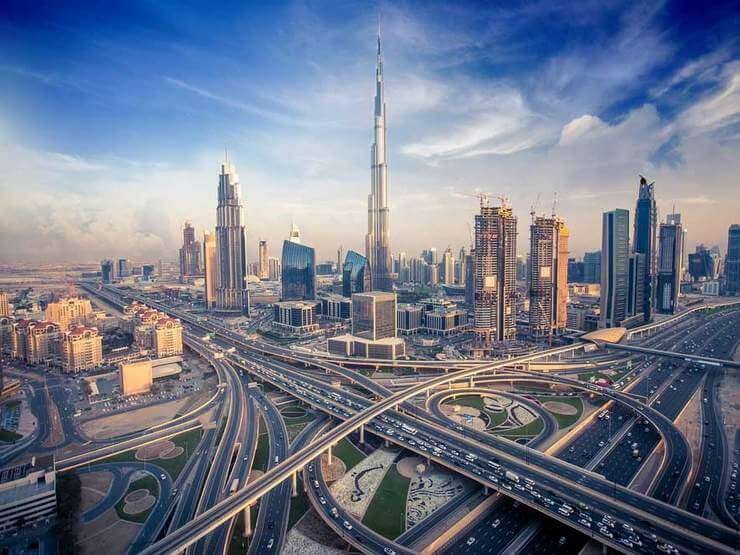

Sheikh Zayed Road is the central urban highway and vertical skyline corridor of Dubai, forming the city’s most important commercial and residential spine. While it is officially part of the E11 federal highway that runs across multiple emirates, the “Sheikh Zayed Road” name is primarily associated with the high-rise stretch that crosses Dubai from the Trade Centre and DIFC zone down toward Jebel Ali.
As an area concept in real estate and urban planning, Sheikh Zayed Road is not a single gated community but a linear mixed-use zone made up of residential towers, office skyscrapers, hotels, serviced apartments, retail podiums, and exhibition centers. It connects major districts such as World Trade Centre, DIFC, Downtown Dubai, Business Bay, Al Safa, Al Barsha, Internet City, Media City, Dubai Marina, and JLT.
From a semantic real estate perspective, Sheikh Zayed Road functions as:
- A transport and infrastructure backbone
- A commercial and financial corridor
- A high-rise residential belt
- A hotel and serviced apartment cluster
- A landmark and tourism axis
This makes it highly relevant for residents, investors, business travelers, and companies seeking central positioning.
Sheikh Zayed Road: Location, Route Structure
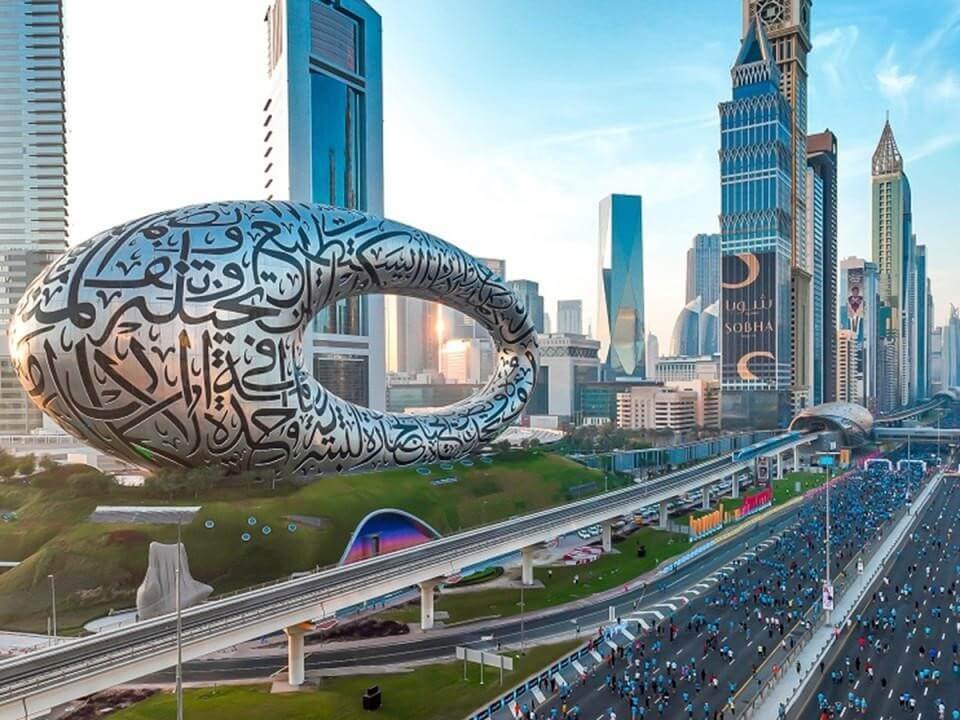
Sheikh Zayed Road runs roughly north-south through Dubai and forms the city’s primary arterial road. Within Dubai, it extends from the Oud Metha / Trade Centre interchange area toward Jebel Ali near the Dubai-Abu Dhabi border. It also links outward as part of the longer E11 route connecting multiple emirates.
Along its Dubai stretch, the corridor passes or connects directly to:
- Dubai World Trade Centre district
- Dubai International Financial Centre (DIFC)
- Downtown Dubai and Burj Khalifa zone
- Business Bay
- Al Safa and Al Wasl connections
- Al Barsha and Mall of the Emirates area
- Dubai Internet City and Media City
- Dubai Marina and Jumeirah Lake Towers
- Jebel Ali and logistics zones
Because of this alignment, Sheikh Zayed Road acts as a distribution layer for access rather than a single neighborhood. Living or working here means being positioned between multiple prime districts instead of inside only one.
Skyline, Landmarks and Architectural Identity
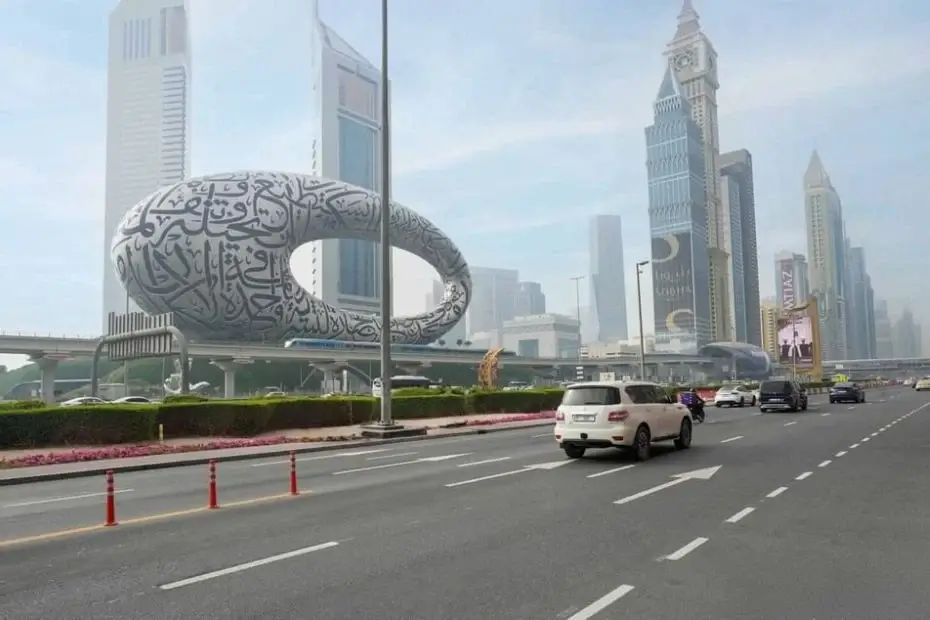
Sheikh Zayed Road is globally recognized for its dense concentration of landmark towers and signature architecture. The corridor visually represents Dubai’s modern identity and rapid vertical development.
Major landmarks and destination anchors along or directly off the corridor include:
- Museum of the Future – a distinctive architectural icon with calligraphy façade
- Emirates Towers – twin landmark skyscrapers combining office and hotel use
- Dubai World Trade Centre – a major exhibitions and events venue
- Burj Khalifa and Dubai Mall – accessible via nearby interchanges and metro links
- Gevora Hotel and other super-tall hotels
- Dubai Water Canal crossings
- Direct access corridors toward Palm Jumeirah and Dubai Marina
This landmark density increases the hospitality, retail, and short-stay demand in nearby towers and hotels.
Property Types on Sheikh Zayed Road
Sheikh Zayed Road is primarily a vertical property market. The dominant supply consists of towers rather than villas or low-rise communities. The mix supports both living and working within the same corridor.
Residential Property Profile
Most residential stock includes:
- Studio to 4-bedroom apartments
- High-floor luxury units
- Penthouses in select towers
- Serviced apartments
- Hotel apartments for long stays
Common building features include:
- Central air conditioning and building management systems
- Podium or multi-level parking
- Shared gyms and pools
- Concierge and security
- Retail and dining at ground or podium level
Some towers offer direct skyline or Burj Khalifa views depending on positioning and height.
Commercial Property Profile
Commercial supply is equally strong and includes:
- Fitted and shell-and-core offices
- Full-floor corporate spaces
- Co-working hubs
- Retail showrooms and street-level shops
- Hotel office suites
This makes Sheikh Zayed Road suitable for companies that want brand visibility + transport access.
Freehold vs Leasehold Status and Ownership Notes
Traditionally, many Sheikh Zayed Road plots were leasehold. However, selected plots have been designated for conversion eligibility to freehold under Dubai Land Department frameworks. This creates hybrid ownership patterns across the corridor.
Implications for buyers and investors:
- Not every building has the same ownership structure
- Title type must be checked tower by tower
- Conversion eligibility can affect long-term value and buyer pool
- Due diligence is essential before purchase
Rental and Sales Market Behavior (Trend Level)
Sheikh Zayed Road shows consistent transaction activity due to:
- Central positioning
- Office demand
- Hotel and serviced apartment absorption
- Strong tenant pool of professionals
Market behavior characteristics (trend-based, not price-specific):
- Rental demand remains steady for centrally located towers
- Serviced and hotel apartments show higher ticket but flexible demand
- Office rents vary significantly by tower grade and fit-out
- Sales volumes are driven by tower quality and ownership structure
Compared with master-planned communities, SZR behaves more like a corridor market than a neighborhood market.
Connectivity is the strongest functional advantage of Sheikh Zayed Road. It supports private vehicles, metro transit, buses, and taxis at scale.
Road Network and Driving
The highway expands to multiple lanes in each direction and carries some of the heaviest traffic volumes in the UAE.
Key driving attributes:
- Urban speed limits generally around the 100-120 km/h range (digitally controlled)
- Dynamic signage adjusts limits in weather conditions
- Multiple Salik toll gates across the corridor
- Major interchanges distribute traffic toward core districts
Peak congestion typically occurs during weekday morning and evening commute windows.
Dubai Metro Red Line
The Dubai Metro Red Line runs parallel to most of Sheikh Zayed Road, making it one of the most metro-served corridors in the city.
Important stations along the axis include:
- World Trade Centre
- Emirates Towers
- Financial Centre
- Burj Khalifa / Dubai Mall
- Business Bay
- Mall of the Emirates
- Dubai Internet City
- Dubai Marina / DMCC
For many commuters, the metro is faster than driving during peak hours.
Hotels and Serviced Living Along the Corridor
Sheikh Zayed Road is one of Dubai’s top hotel clusters, serving business travelers, exhibition visitors, and tourists.
Hotel and serviced apartment categories include:
- Five-star business hotels
- Luxury tower hotels
- Extended-stay hotel apartments
- Branded serviced residences
These properties are typically concentrated around:
- Trade Centre
- DIFC edge
- Downtown access points
- Central SZR tower clusters
This concentration supports strong short-term rental and executive stay demand.
Shopping, Dining and Entertainment Access
Sheikh Zayed Road provides direct or near-direct access to multiple major malls and lifestyle zones rather than relying on a single community mall.
Key retail and mall destinations linked to the corridor:
- Mall of the Emirates
- Oasis Mall
- Times Square Center
- Dubai Marina Mall
- Ibn Battuta Mall (toward Jebel Ali side)
- Dubai Mall (via Downtown connection)
Dining supply is layered across:
- Hotel fine dining venues
- DIFC restaurant clusters
- Casual dining strips behind tower rows
- Fast food and café chains at podium levels
Nightlife venues are commonly located inside SZR hotels and nearby DIFC and Downtown zones.
Schools, Universities and Healthcare Access
Sheikh Zayed Road itself is not school-dense, but it is school-accessible within short drive times to adjacent districts.
Nearby education options include:
- British curriculum schools
- IB curriculum schools
- Indian curriculum schools
- Multiple nurseries and early learning centers
- Canadian University of Dubai and professional institutes nearby
Healthcare coverage includes:
- Specialty hospitals within short driving distance
- Multi-specialty clinics inside towers
- Private medical centers and polyclinics
- Orthopedic, women & children, and surgical hospitals nearby
This supports long-term residency but may require short commutes for schooling.
Leisure, Parks and Recreation
Although SZR is urban and vertical, it is close to several major leisure zones.
Nearby outdoor and recreation assets include:
- Zabeel Park – large urban park with family facilities
- Al Satwa Park – smaller community park
- Dubai Water Canal promenade
- Kite Beach, Jumeirah Beach, and JBR Beach within short drive
- Hotel gyms and premium fitness clubs
- Boutique gyms and beauty salons inside towers
Residents trade internal green space for citywide accessibility.
Advantages and Limitations of Living on Sheikh Zayed Road
Advantages
- Central positioning across Dubai
- Direct metro coverage
- Strong office and business access
- Wide choice of towers and serviced units
- Landmark surroundings and skyline views
- High rental liquidity in many buildings
Limitations
- Traffic congestion at peak hours
- Noise and density typical of highway corridors
- Limited low-rise family community feel
- Parking pressure in some towers and retail strips
- Ownership structure varies by building
Who Should Consider Sheikh Zayed Road
Sheikh Zayed Road is best suited to people who prioritize connectivity and centrality over community seclusion.
It is particularly suitable for:
- Corporate professionals working across multiple districts
- Consultants and executives with frequent travel
- Exhibition and event industry workers
- Investors targeting rental demand near business zones
- Tenants seeking metro-adjacent high-rise living
It is less suitable for buyers seeking villa communities, gated suburban living, or low-traffic environments.
FAQs
Is Sheikh Zayed Road a community or a road?
It is primarily a highway corridor that functions as a mixed-use urban strip with residential, commercial, and hotel towers rather than a single master-planned community.
How long is Sheikh Zayed Road?
As part of the E11, the full highway spans across multiple emirates, but the commonly referenced Dubai stretch is about 55 km.
Is there metro access along Sheikh Zayed Road?
Yes. The Dubai Metro Red Line runs parallel to most of the corridor with many stations serving tower clusters.
Are properties on Sheikh Zayed Road freehold?
Some plots and towers are eligible for or already converted to freehold, while others remain leasehold. Each building must be checked individually.
Is it good for property investment?
It can be attractive for rental-focused investment due to central demand, but tower quality, ownership status, and unit layout strongly affect performance.
Conclusion
Sheikh Zayed Road is not just a transport route; it is Dubai’s most important vertical urban corridor. It combines transport infrastructure, landmark architecture, commercial density, and high-rise residential living into a single continuous axis. For professionals, investors, and city-centric residents, it offers unmatched connectivity and positioning. However, it trades suburban calm for metropolitan intensity. Choosing the right tower and ownership structure is the key to making a successful residential or investment decision here.


Leave a Reply