
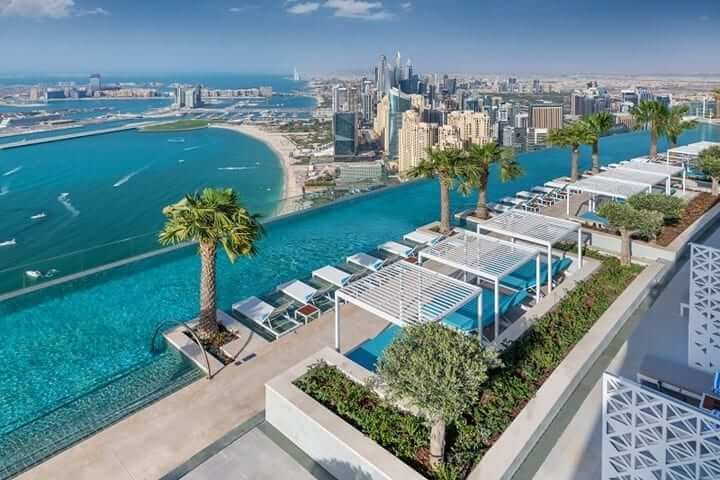

Jumeirah Beach Residence, known to almost everyone in Dubai simply as JBR, is a 1.7-kilometre stretch of beachfront towers on the Arabian Gulf, sitting directly alongside Dubai Marina. It is one of the few places in the city where you can genuinely walk out of your apartment lobby and be on the sand within two minutes. That single fact shapes almost everything else about the community: its property prices, its tenant mix, its traffic, and its identity as both a residential neighbourhood and one of Dubai’s busiest tourist destinations.
This guide covers what JBR actually offers residents and investors in 2026 – the clusters, the property market, the lifestyle, the schools and healthcare nearby, and an honest look at where it makes sense to buy or rent, and where it doesn’t.
What Is Jumeirah Beach Residence?
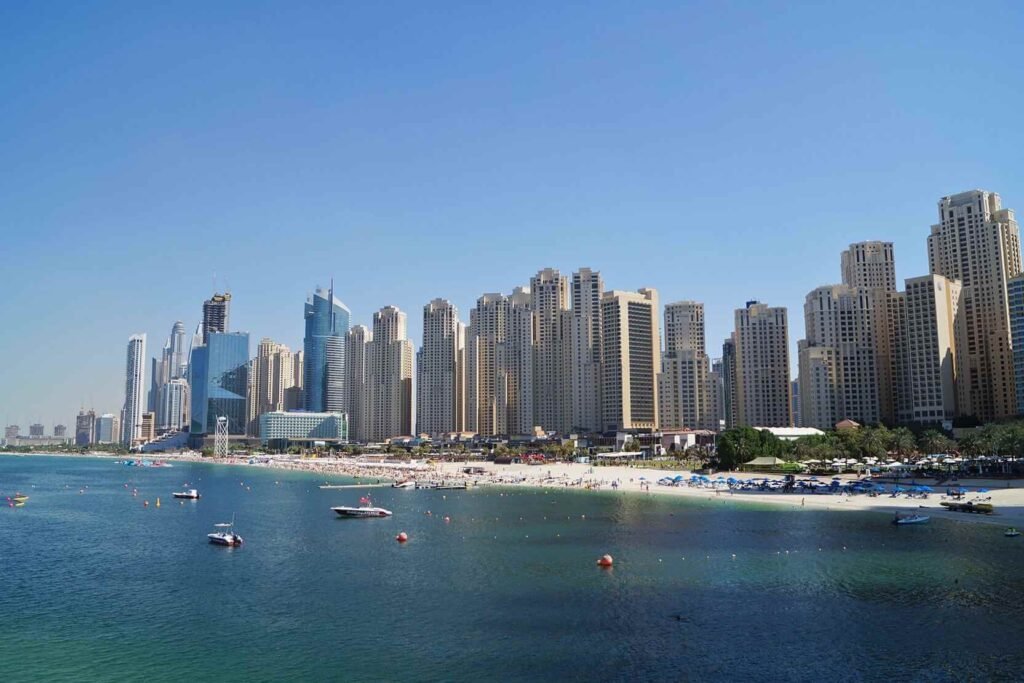
JBR is a mixed-use, freehold waterfront development built by Dubai Properties, a subsidiary of Dubai Holding. Construction began in 2002 and the project – described at the time as the largest single-phase residential development in the world – was completed in 2010 at a cost of roughly AED 6 billion. It comprises 40 towers, 35 of which are residential and five of which are hotels, arranged along the coast, with the whole community able to house around 15,000 residents across roughly 6,900 apartments.
Architecturally, JBR leans into a Mediterranean-meets-Arabian style: sand-toned facades, low podium levels with landscaped courtyards, and towers that step back from a ground-floor retail strip. That strip is The Walk, a 1.7 km pedestrian promenade lined with restaurants, cafés and shops, and it’s the single most recognisable feature of the community. On the seaward side sits The Beach, an open-air retail and dining complex built directly on the sand by Meraas, offering unobstructed views across the water toward Ain Dubai on Bluewaters Island.
In short: JBR is a self-contained, walkable seaside district built for a resort-style, high-density urban lifestyle – not a quiet suburban community.
Location, Connectivity & Surrounding Landmarks
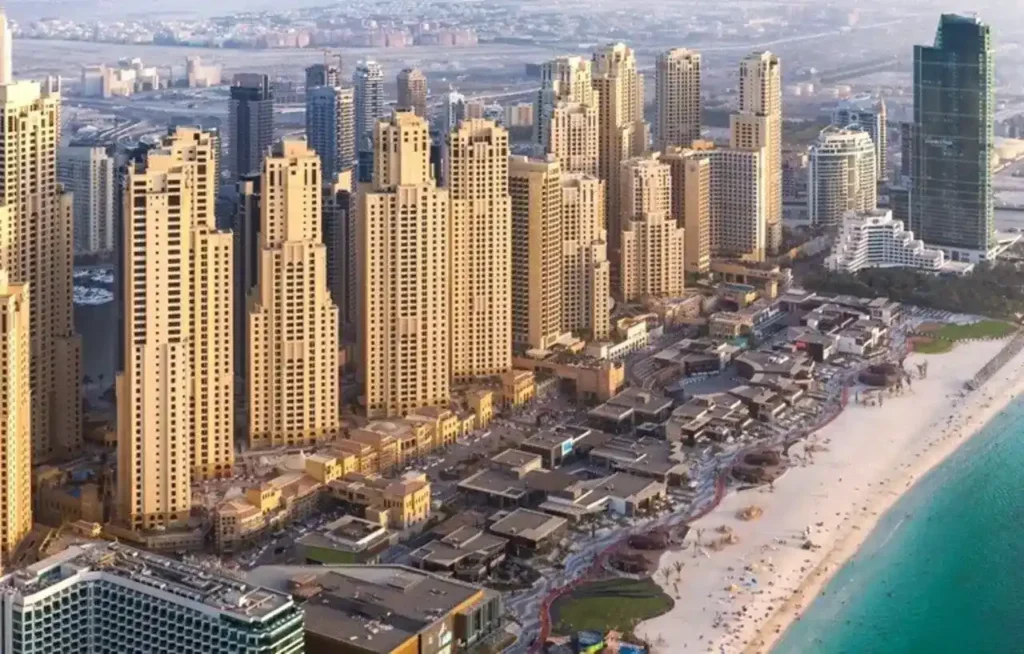
JBR sits on the Arabian Gulf coast within the wider Dubai Marina district, flanked by Sheikh Zayed Road to the east and the sea to the west. Its position gives residents fast access to several of Dubai’s key business and leisure hubs without needing to cross the city.
Dubai Marina is immediately adjacent, reachable on foot from several JBR towers. Dubai Media City and Dubai Internet City – two of the largest employment hubs on this side of the city – are roughly ten to fifteen minutes away by car, which is one reason JBR attracts a strong base of media, tech and marketing professionals as tenants. Downtown Dubai and Dubai International Financial Centre are around 25 to 30 minutes away via Sheikh Zayed Road, and Dubai International Airport is approximately a 30-minute drive, with Al Maktoum International Airport around 25 to 30 minutes in the opposite direction.
Public transport is one of JBR’s genuine strengths. The community is served by two tram stations, JBR 1 and JBR 2, which connect to Dubai Marina Mall, Jumeirah Lake Towers, Media City and the Palm Jumeirah gateway station, and the tram also links onward to the DMCC and Sobha Realty Dubai Metro stations. That means a resident without a car can realistically commute across the northern half of the city using tram-to-metro connections, something not every beachfront community in Dubai can offer.
Directly across the water sits Bluewaters Island, home to Ain Dubai – the world’s largest observation wheel – plus Caesars Palace Bluewaters Dubai, Banyan Tree Dubai, and a growing retail and residential precinct of its own. A 264-metre pedestrian bridge connects JBR to Bluewaters, so residents can walk between the two communities, which effectively doubles the leisure options available on foot.
The Six Residential Clusters of JBR
JBR is organised into six residential clusters running west to east along the coast: Shams, Amwaj, Rimal, Bahar, Sadaf and Murjan. Each cluster groups several towers together, and while the general lifestyle offering is consistent across all of them, there are meaningful differences worth understanding before you buy or rent.
Shams sits at the western end of JBR, closer to Dubai Marina, and is known for a slightly quieter position relative to the busiest stretch of The Walk while still being close to several beach clubs and hotels.
Amwaj is centrally positioned and includes some of JBR’s taller, more premium towers with strong sea views on higher floors.
Rimal, developed directly by Dubai Properties, consists of six towers and is popular with investors thanks to a consistent supply of one- to four-bedroom units and top-floor penthouses with Palm Jumeirah views.
Bahar sits mid-strip with direct proximity to some of the busiest sections of The Beach and The Walk, making it a strong short-term rental location but also one of the noisier clusters at night.
Sadaf, comprising eight towers ranging from 34 to 48 storeys, is one of the larger clusters by unit count and tends to attract a heavy mix of investors and holiday-home operators due to unit variety and price accessibility.
Murjan, at the eastern end nearest Dubai Marina and Sheikh Zayed Road, offers views toward Palm Jumeirah and Bluewaters and includes some of the newer duplex penthouse stock in the community.
For buyers, the practical takeaway is this: Shams and Murjan (the two ends) tend to be marginally quieter and better for families or long-term residents who want easier road access, while Amwaj, Bahar and Sadaf sit closer to the busiest stretch of nightlife and retail – better suited to investors targeting short-term rental income or residents who genuinely want to be in the middle of the action.
Lifestyle: The Walk, The Beach & Daily Life in JBR
Life in JBR revolves around two features: The Walk and The Beach. The Walk is where daily errands happen – coffee, groceries, casual dining – while The Beach functions more as the destination retail and leisure strip, with international restaurant brands, a cinema, and beachfront lounges that stay busy well into the evening.
The Walk at JBR is lined with shops, cafés and restaurants along its full 1.7 km length, and The Beach complex adds international dining, a cinema and further beachfront leisure activities on top of that. Beyond dining, residents have access to watersports operators along the shoreline, Skydive Dubai’s beachfront drop zone, seasonal beach volleyball courts, and children’s play areas at podium level in most towers.
For groceries and everyday retail beyond The Walk, Dubai Marina Mall is a short tram ride away and covers supermarkets, banking, and a wider retail mix than JBR itself offers at street level.
A fair note on the trade-offs: JBR’s popularity is also its biggest daily friction point. The single access road through the community is consistently congested, and while the Dubai Tram was intended to ease traffic, the tram stations and tracks added their own congestion at street level. Weekend evenings and public holidays bring heavy footfall from visitors across Dubai, not just residents, and street parking is limited and largely paid. If quiet predictability matters more to you than energy and walkability, this is the honest downside to weigh against the lifestyle upside.
Schools, Healthcare & Family Amenities
JBR itself does not contain full K-12 schools, but it is well served by nurseries at ground level, and reputable schools sit a short drive away. Nurseries within JBR include Toddler Town British Nursery and British Orchard Nursery, both catering to early years education, and additional options such as Kidville Nursery and Willow Children’s Nursery operate in the surrounding towers.
For school-age children, GEMS Wellington International School in Al Sufouh and Dubai British School in Jumeirah Park are both within easy driving distance, typically 15 to 20 minutes depending on traffic, and Emirates International School in The Meadows is a similarly short drive.
On healthcare, Medcare Medical Centre and Emirates Hospitals Clinic both operate within JBR itself for day-to-day medical needs, with larger specialist hospitals such as Saudi German Hospital and Al Zahra Hospital in Al Barsha around 15 minutes away for anything requiring a full hospital setting.
Combined with pram-friendly podium walkways, shared pools, and a genuinely walkable beach, this makes JBR realistically workable for families with young children – even though the loudest marketing around the area tends to emphasise nightlife and tourism.
Property Types & Prices in JBR (2026)
JBR’s housing stock runs from compact studios to five-bedroom penthouses, spread across roughly 6,900 apartments in the original towers, plus a smaller number of newer-generation units in later additions like One JBR, La Vie, Five JBR and Address Jumeirah Resort + Spa.
As of early-to-mid 2026, indicative pricing across the market looks like this:
- Studios: roughly AED 900,000 to AED 1.6 million, typically 500–700 sq ft, popular with investors chasing the highest percentage yields.
- One-bedroom apartments: approximately AED 1.4 million to AED 2.5 million, 800–1,200 sq ft.
- Two-bedroom apartments: the most actively traded configuration, ranging from around AED 2.8 million for non-sea-view units in standard towers up to AED 6 million-plus for full sea-view units in premium clusters like Sadaf, Rimal and Shams.
- Three- and four-bedroom apartments and penthouses: generally AED 5 million upward, with top-floor penthouses in newer towers such as One JBR and La Vie reaching well into double-digit millions.
Average price per square foot across JBR generally sits between AED 1,900 and AED 2,300, though this varies meaningfully by tower age, floor level and view – older, non-sea-view stock in the original six clusters can trade closer to AED 1,600–1,800 per sq ft, while newer beachfront towers command a clear premium.
It is worth noting explicitly: JBR’s core 1.7 km stretch is essentially built out. There is very limited land available for new towers within the original community, which is one reason older stock retains value – supply simply cannot expand the way it can in newer master-planned districts elsewhere in Dubai. Most of what buyers describe as “new JBR supply” is actually happening next door, on Bluewaters Island or within the broader Dubai Harbour development.
What You Also Need to Budget For
Beyond the purchase price, buyers should factor in the Dubai Land Department’s 4% transfer fee, standard agency commission (typically around 2%), and ongoing service charges, which in JBR generally range from roughly AED 12 to AED 24 per sq ft per year depending on the tower’s age, facilities and management quality – older towers with ageing lift and cooling infrastructure tend to sit at the higher end of that range. This is a detail many area guides skip, but it materially affects net returns, especially on smaller units where service charges represent a larger share of rental income.
Rental Market & Investment Yields
JBR’s rental market is unusual in Dubai because it runs on two distinct engines: long-term residential leasing and short-term holiday-home rental, and the two behave differently.
On long-term annual leases, gross rental yields in JBR typically sit in the 5% to 7% range, varying by unit size and view. Two-bedroom apartments without sea views tend to sit toward the higher end of that band (around 6–7%), because they combine a moderate purchase price with strong, consistent family and professional tenant demand. Studios and one-bedroom units, which appeal to the highest volume of renters, can push toward 7–8.5% gross in well-located, well-furnished towers.
On short-term and holiday-home rental, sea-view units – particularly in Sadaf, Rimal and Shams – can generate materially higher income, with some operators reporting 8–10% gross yields on beachfront-facing apartments let through licensed holiday-home platforms, reflecting JBR’s status as one of Dubai’s most visited tourist strips. That premium comes with real operating effort: licensing through Dubai’s short-term rental permit system, furnishing to a tourist-facing standard, and active guest turnover management, either self-managed or through a professional operator.
For context on positioning, recent market analysis has flagged JBR – alongside Palm Jumeirah and Downtown Dubai – as having comparatively lower net yields than newer, higher-supply communities such as Jumeirah Village Circle or Dubai Sports City, once service charges and financing costs are factored in. That is not a reason to avoid JBR; it reflects the trade-off inherent to any mature, prestige, beachfront address: you are paying partly for scarcity and lifestyle, and the return on that shows up more in long-run capital stability and rental resilience than in headline yield percentage. Investors chasing the highest possible yield-on-paper should compare JBR honestly against inland growth communities before deciding; investors prioritising a scarce, tourism-anchored, beachfront asset with dependable occupancy will find JBR’s fundamentals hard to replicate elsewhere in Dubai.
Tenant demand in JBR skews toward a mix of Western expatriates, young professionals working in nearby Media City and Internet City, and – on the short-term side – international tourists, with demand for annual contracts historically strongest between October and April, Dubai’s peak season.
Can Foreigners Buy Property in JBR?
Yes. JBR is a designated freehold area, meaning foreign nationals – not just UAE and GCC citizens – can purchase full ownership of apartments, including land share, with no local sponsor or partner required. This is one of the reasons JBR has attracted international buyers since the original towers were released for sale in the early-to-mid 2000s.
The buying process itself follows Dubai’s standard freehold transaction path: agree terms and sign a Memorandum of Understanding (Form F) with the seller, pay a deposit (commonly 10%), obtain a No Objection Certificate from the developer confirming no outstanding service charges, and complete final transfer at a Dubai Land Department registration trustee office, where the 4% transfer fee is paid and the new Title Deed is issued. Buyers financing the purchase will also need mortgage pre-approval from a UAE bank before this stage, and non-resident buyers should budget extra time for the associated paperwork.
Property ownership of AED 2 million or more can also support eligibility for the UAE’s Golden Visa long-term residency programme, which is a relevant consideration for investors buying above the AED 2 million two-bedroom threshold that much of JBR’s stock sits around or above.
JBR vs Dubai Marina vs Bluewaters Island vs Palm Jumeirah
Buyers comparing JBR to its immediate neighbours are usually weighing one core trade-off: direct beach access versus other advantages like density, newness, or exclusivity.
JBR vs Dubai Marina: Dubai Marina offers a larger, denser selection of newer towers, marina-facing rather than open-sea-facing views, and typically 20–35% lower entry prices with slightly higher long-term rental yields. What Marina cannot offer is JBR’s direct sand-to-lobby beach access – that is JBR’s structural advantage and the reason its short-term rental rates outperform Marina’s by a comparable margin.
JBR vs Bluewaters Island: Bluewaters, connected to JBR by a pedestrian bridge, offers a newer, more curated built environment and views of Ain Dubai, but with a smaller total unit count, a more limited retail base of its own, and pricing that generally sits at a premium to comparable JBR stock.
JBR vs Palm Jumeirah: Palm Jumeirah sits a tier above on prestige and branded-residence pricing, and its best short-term rental units out-earn JBR’s on a nightly-rate basis. But per-dirham invested, JBR often delivers more efficient yield, because entry prices are meaningfully lower for a broadly comparable beachfront lifestyle.
There is no universally “better” answer among these four – the right choice depends on whether the buyer is optimising for yield efficiency (Marina), curated newness (Bluewaters), prestige and branded ownership (Palm Jumeirah), or the strongest combination of walkable lifestyle and tourist-driven income at a moderate entry price (JBR).
Who JBR Actually Suits
JBR works well for young professionals who want to walk to work-adjacent leisure and don’t mind noise and footfall; for couples and small families who prioritise beach access and an active, social community over suburban quiet; and for investors specifically targeting short-term or holiday-home income from a location with genuine, non-seasonal tourist demand.
It suits less well those who want a quiet, low-traffic residential setting, buyers chasing the highest possible net yield percentage regardless of location, or families who need on-site, walk-to schools rather than a short drive to one.
FAQs
What is Jumeirah Beach Residence known for?
JBR is known as Dubai’s most walkable beachfront community, built around a 1.7 km promenade called The Walk and a beachfront retail strip called The Beach, with 40 towers offering direct access to the Arabian Gulf.
Is JBR the same as Jumeirah Beach?
No. Jumeirah Beach refers broadly to Dubai’s coastline in that part of the city, while Jumeirah Beach Residence (JBR) is the specific freehold residential and commercial development built along a section of that coastline.
Is JBR a good place to live?
For people who want an active, walkable, beach-oriented lifestyle close to Dubai Marina and Media City, JBR is one of the strongest matches in Dubai. It’s less suited to those who prioritise quiet streets and minimal footfall.
Is JBR expensive?
Rental and sale prices in JBR generally run 10–20% above comparable units in Dubai Marina or Jumeirah Lake Towers, reflecting its direct beachfront position and amenity base.
Can foreigners buy property in JBR?
Yes. JBR is a designated freehold area, allowing full foreign ownership of apartments without a local partner or sponsor.
What is the best cluster to buy in within JBR?
It depends on the goal: Shams and Murjan at the two ends tend to be quieter and better for long-term residents; Bahar, Amwaj and Sadaf sit closer to the busiest stretch and tend to suit investors targeting short-term rental income.
What is the average price per square foot in JBR?
Typically AED 1,900–2,300 per sq ft across the community as a whole in 2026, with older non-sea-view stock lower and premium sea-view or newer towers higher.
What rental yield can I expect in JBR?
Long-term annual leases generally deliver 5–7% gross yield; sea-view units let on a short-term or holiday-home basis can reach 8–10% gross, before accounting for management and licensing costs.
Is JBR walkable?
Yes, JBR is one of the most walkable communities in Dubai. The Walk connects the full length of the community at street level, and a pedestrian bridge links directly to Bluewaters Island.
How do I get to JBR by public transport?
JBR is served by two Dubai Tram stations (JBR 1 and JBR 2), which connect onward to the DMCC and Sobha Realty Dubai Metro stations, as well as several bus routes running through the community.
Are there good schools near JBR?
JBR has several nurseries on-site, with GEMS Wellington International School and Dubai British School both a short drive away for older children.
Is JBR family-friendly?
Yes, with caveats. Podium-level pools, play areas and beach access work well for families, but the busy promenade and nightlife-driven evening crowds are worth weighing for those with very young children.
What is service charge like in JBR?
Service charges typically range from roughly AED 12 to AED 24 per sq ft annually, depending on the tower’s age and facilities – a real cost that affects net rental returns and should be checked per building before buying.
Is JBR a good investment in 2026?
JBR remains a stable, tourism-anchored investment with limited new beachfront supply supporting price resilience. It generally trades lower net yield than newer inland communities but offers stronger occupancy consistency and a scarcity advantage that’s difficult to replicate elsewhere in Dubai.
What’s the difference between JBR and Bluewaters Island?
Bluewaters is a separate, newer island community connected to JBR by a pedestrian bridge, offering a more compact, curated environment with views of Ain Dubai, generally at a price premium to comparable JBR units.

Leave a Reply