
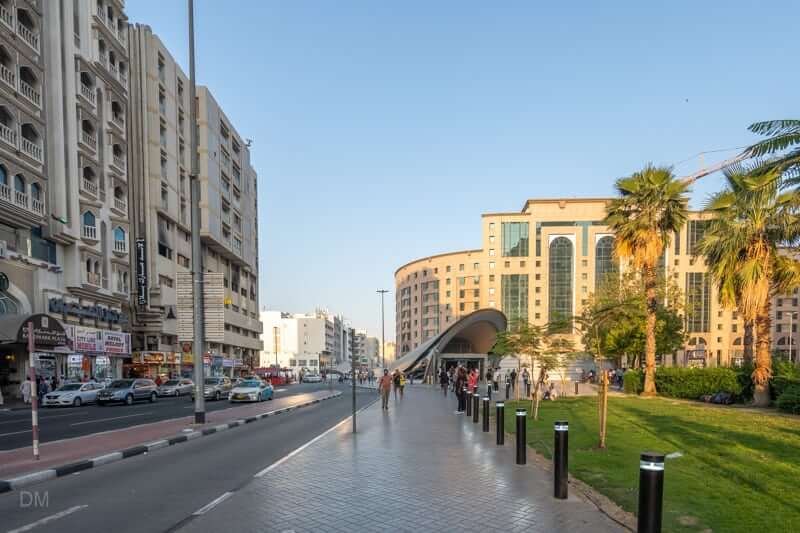

Naif Road sits in the middle of one of Dubai’s oldest neighbourhoods, and if you’ve heard the name without quite placing it, that’s normal – most people know it by what happens on it rather than where it is. It’s the street tenants describe as “near the souk,” the one delivery drivers use as a shortcut through Deira, and the strip where a studio apartment still rents for a fraction of what the same 300 square feet costs in Downtown or Marina.
This guide explains what Naif Road actually is, where its boundaries sit, what it’s like to live, rent, shop, or invest here in 2026, and how it compares to nearby Deira communities – so you can decide whether it fits what you’re looking for.
What Is Naif Road, Deira?
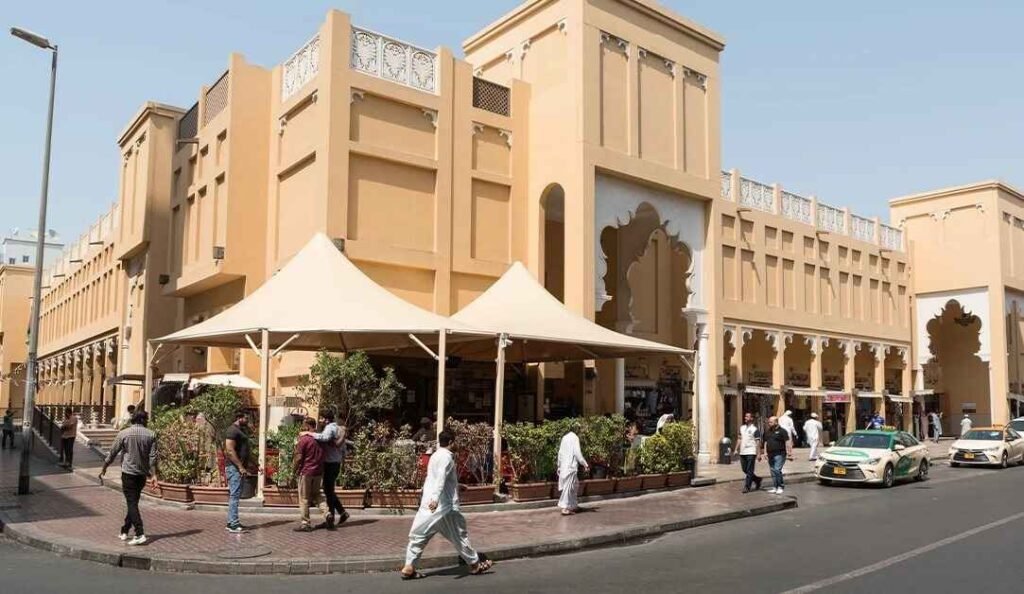
Naif Road (also written Naif Street or Al Naif Road) is the main commercial artery running through Naif, a sub-community of Deira on the eastern bank of Dubai Creek. Naif itself is one of Dubai’s oldest and most densely populated residential-commercial districts, historically built up around trade, and today it functions as a self-contained pocket of low- and mid-rise buildings, wholesale shops, and budget-to-mid-range housing.
The name traces back to Naif Fort, built in the mid-1930s to serve as the original headquarters of the Dubai Police Force. That heritage core – now home to the small Naif Museum – is part of why the area still carries a distinct old-Dubai identity even as the rest of the city has moved toward master-planned communities.
Naif Road itself is short but busy: a continuous strip of ground-floor shops (electronics, hardware, tailoring, mobile accessories, second-hand furniture, exchange houses) with residential and hotel floors stacked above. It’s less a “street” in the leafy suburban sense and more a working commercial spine that the surrounding residential blocks are built around.
Naif Deira Dubai Location and Boundaries
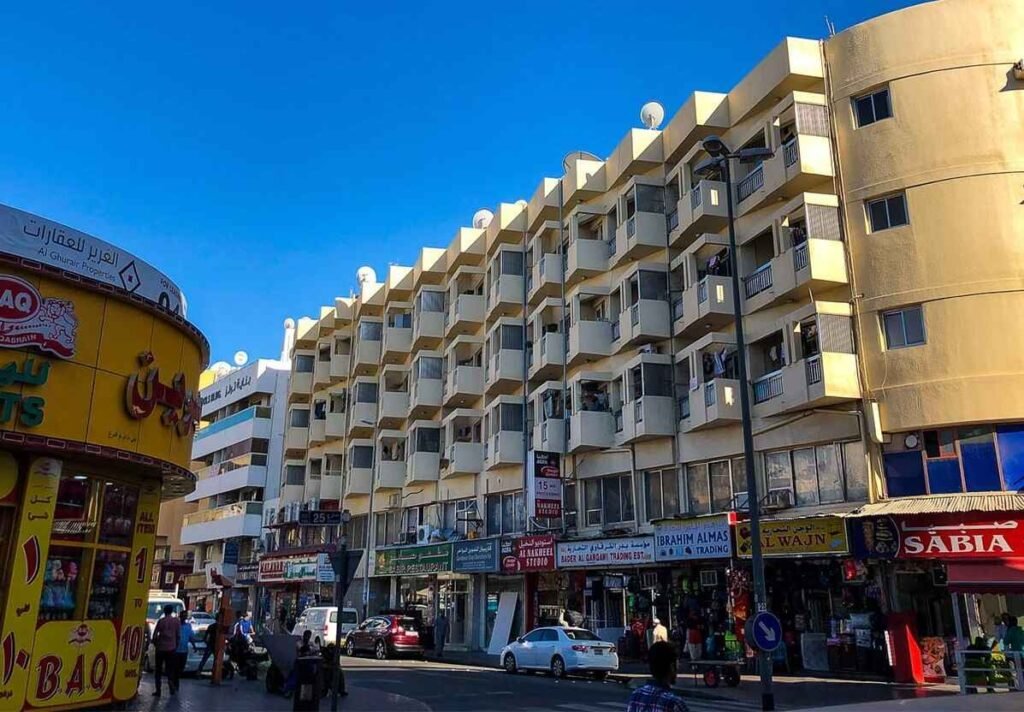
Naif sits just north of Baniyas Square and a short walk from the Dubai Creek waterfront, roughly 10 minutes by car from both the Creek and the Deira Corniche. It’s bordered by, and closely connected to, several other Deira sub-communities: Al Murar, Al Muteena, Al Muraqqabat, and Al Baraha, with Al Rigga a few minutes further west.
The community’s defining edges are Naif Street itself, Omar Bin Al Khattab Road, Al Maktoum Hospital Road, and Al Sabkha Road – a compact grid of roughly half a square kilometre that nonetheless houses tens of thousands of residents, making it one of the most densely populated pockets in Dubai.
This central position is actually the area’s biggest practical advantage: from Naif Road you can walk to Baniyas Square, reach Al Sabkha’s abra (ferry) crossing to Bur Dubai in minutes, and get to Dubai International Airport by road faster than from most northern Dubai suburbs.
Getting Around: Transport and Connectivity
Naif is built for people who don’t drive everywhere, and that’s a genuine selling point rather than a compromise.
Metro. The closest station is Baniyas Square Metro Station on the Green Line, within easy walking distance of most of Naif Road. From there, the Green Line connects directly to Union (interchange with the Red Line toward Deira City Centre, Dubai World Trade Centre, and Sheikh Zayed Road) and on to Al Jafiliya and beyond.
Bus. RTA bus routes run through and around Naif, with Union and Al Sabkha bus stations just outside the community and within walking distance, adding further coverage for destinations the metro doesn’t reach directly.
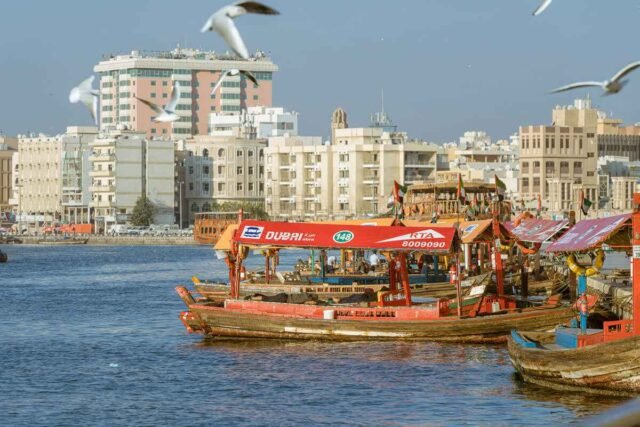
Abra (water taxi). Because Naif backs onto the Creek, residents can use the Al Sabkha Marine Transport Station to cross by traditional abra to Bur Dubai – a slower but genuinely scenic and cheap alternative to the metro or a taxi.
Road and taxi. Naif Road connects to Omar Bin Al Khattab Road and Al Maktoum Hospital Road, giving reasonably quick car access to Dubai International Airport, Deira City Centre, and Sheikh Zayed Road corridors. Taxis and ride-hailing (Uber, Careem) are readily available, which matters because on-street parking is genuinely limited – most residential and commercial buildings offer only a handful of reserved bays, so car-owning tenants should confirm parking availability before signing a lease.
Walkability. Naif is compact and largely walkable for daily errands – groceries, pharmacies, tailors, and cafés are typically within a few minutes on foot, which is unusual for Dubai and one of the area’s more underrated qualities.
Naif Souk, Naif Park, and Local Landmarks
Naif Souk (Souk Naif) is the area’s commercial anchor and one of Dubai’s lesser-known shopping destinations – a dense market of small shops selling everything from textiles and household goods to electronics and hardware, reflecting the wholesale-trade character that shaped the whole district. It draws steady daily footfall rather than tourist crowds, which gives it a more authentic, working-market feel than the more famous Gold and Spice Souks nearby.
Baniyas Square is the community’s other key public space – a landmark roundabout and gathering point lined with shops, including well-known retailers for affordable homeware, and a common meeting reference point (“near Baniyas Square”) for anyone giving directions in the area.
Naif Park (Naif Family Park) offers a rare patch of green space and shaded walking paths in an otherwise densely built-up district, popular with families in the surrounding residential blocks.
Other reference points include the Naif Museum, housed in the restored Naif Fort building, and Al Maktoum Hospital, one of the longer-established hospitals in Deira, which also lends its name to one of the area’s boundary roads.
Who Lives in Naif – and Why
Naif’s population is predominantly South Asian expatriates, many working in the trading, retail, and small business sectors that the area itself is built around. It is one of Dubai’s most densely populated localities, and that density is visible in the compact building stock and constant street-level activity – this is not a quiet, leafy residential suburb, and it isn’t trying to be one.
What draws people here is straightforward: affordability relative to location, genuine walkability, strong public transport, and proximity to jobs in Deira’s wholesale and retail trade. It particularly suits bachelors, small families on a budget, and business owners who want to live close to where they work.
Families weighing Naif should factor in the trade-offs honestly: building quality varies significantly (this is old housing stock, so unit condition depends heavily on the specific building and its management), open green space is limited to pockets like Naif Park, and the street-level environment is busy and commercial rather than residential-quiet. For many residents, the connectivity and cost savings outweigh these factors; for others prioritising a quieter, newer-build environment, a nearby community like Al Muraqqabat or Al Rigga may be a better fit.
Property Types in Naif: What’s Available
Naif’s building stock is almost entirely low- to mid-rise apartment blocks, mixed with commercial buildings and a cluster of budget and mid-range hotels – there are no villas, townhouses, or standalone plots in this part of Deira; it is an apartment- and retail-dominated market.
Residential apartments range from studios up to three-bedroom units, with three-bedroom apartments in some buildings including a maid’s room. Studios are by far the most common and most in-demand unit type, reflecting the tenant profile of singles and small households.
Hotel apartments are also common along Naif Road itself, aimed at short-stay visitors and budget business travellers, alongside a handful of standalone budget hotels (mostly 1- to 3-star) directly on the street.
Commercial and retail space – ground-floor shops, small offices, and wholesale units – makes up a significant share of the built environment, particularly along Naif Road itself, reflecting the area’s identity as a working trade district as much as a residential one.
There is effectively no off-plan development activity within Naif itself; this is a fully built-out, established district rather than a growth corridor, which shapes how it should be evaluated as an investment (see below).
Rental Trends and Price Ranges (2026)
Naif remains one of the more affordable rental pockets close to central Dubai, and pricing reflects unit size and building condition more than location within the district, since the area itself is so compact.
- Studio apartments in Naif typically range from roughly AED 22,000 to AED 47,000 per year, with sizes generally between 180 and 430 square feet. Smaller, older units sit at the lower end; larger or better-maintained studios near Baniyas Square Metro sit toward the upper end.
- One-bedroom apartments generally range from about AED 43,000 to AED 75,000 per year, depending on size (roughly 350–770 sq ft) and building standard.
- Two- and three-bedroom apartments are less common but available, typically starting from around AED 82,000 per year and rising well beyond that for larger family units.
- Monthly rentals are also widely available for furnished studios, often starting from around AED 3,000–3,500 per month, which suits short-term workers and those testing the area before committing to an annual Ejari contract.
These figures move with the wider Deira rental market, so it’s worth checking current live listings before budgeting – but as a rule, Naif consistently prices below the broader Deira average for comparable unit sizes, which is precisely why it draws such steady rental demand.
Buying and Investing in Naif
Naif is a leasehold area, not one of Dubai’s designated freehold zones, so foreign investors cannot purchase full freehold title here the way they can in areas like Business Bay or Dubai Marina. That single fact should shape how any investor approaches this market: Naif is realistically a rental-yield and long-term-leasehold play, or a market for UAE/GCC nationals and eligible buyers, rather than a freehold capital-appreciation story aimed at overseas buyers.
For eligible buyers and long-term leaseholders, the appeal is the same as it is for tenants – consistently high occupancy driven by affordability and connectivity, low vacancy risk given sustained demand from Deira’s trading and retail workforce, and resilient rental yields relative to purchase cost precisely because entry prices are low.
Anyone considering property in Naif – whether residential or the ground-floor retail units that anchor Naif Road’s commercial identity – should verify current freehold/leasehold status and any ownership eligibility directly with the Dubai Land Department (DLD), since zoning classifications and permitted buyer categories can be updated. A licensed RERA-registered brokerage can confirm the specifics for any individual building before you commit.
Shopping, Dining, and Daily Life
Life in Naif runs on small, frequent errands rather than destination shopping trips. Naif Souk and the shops lining Naif Road itself cover most day-to-day needs – groceries, tailoring, mobile phone shops, pharmacies, exchange houses, and modest cafés and casual eateries reflecting the area’s South Asian and Middle Eastern resident mix.
For larger retail or leisure needs, residents typically head to Deira City Centre, reachable via the Red Line from Union Metro Station, or into Bur Dubai via the Al Sabkha abra crossing. This pattern – hyperlocal for daily life, short metro or abra trip for bigger outings – is a big part of what makes Naif practical for car-free living.
Schools, Healthcare, and Family Amenities
Families in Naif are within reach of several established schools in the wider Deira area, including Al Ahmadiya School and other institutions serving the local expatriate community, though Naif itself is not a family-suburb in the way newer master-planned communities are, and school choice often means a short commute rather than a walk.
For healthcare, Al Maktoum Hospital sits directly on one of Naif’s boundary roads, giving residents genuinely close access to emergency and general medical services – a practical advantage that’s easy to overlook but matters day-to-day.
Naif Park is the community’s main dedicated family and children’s space, offering shaded seating and walking paths in an area where private green space is otherwise scarce.
Naif vs. Nearby Deira Communities
Deciding between Naif and its neighbours usually comes down to trading a bit of budget against a bit of quiet, or vice versa.
Compared with Al Rigga, Naif is generally cheaper and quieter at street level but has fewer international dining options and less of a “high street” retail feel. Compared with Al Muraqqabat and Al Baraha, Naif is more compact and arguably better connected to the Creek and the metro, though building stock across all three is broadly similar in age and character. Compared with Bur Dubai across the Creek, Naif offers lower rents for similar connectivity, at the cost of Bur Dubai’s larger retail and cultural landmark base (Meena Bazaar, Al Fahidi).
In short: choose Naif if affordability, transport access, and proximity to Deira’s trading economy are the priority; look slightly further out – Al Rigga, Bur Dubai, or newer Deira Islands developments – if you want more modern building stock, more dining variety, or freehold ownership options.
FAQs
Where exactly is Naif Road located in Dubai?
Naif Road runs through Naif, a sub-community of Deira on the eastern side of Dubai Creek, bordered by Al Murar, Al Muteena, Al Muraqqabat, and Al Baraha, close to Baniyas Square.
Is Naif Road the same as Naif, Deira?
Not exactly – Naif is the wider sub-community, and Naif Road (or Naif Street) is its main commercial artery running through it. People often use the two names interchangeably when referring to the general area.
What is Naif best known for?
Naif is best known for Naif Souk, its dense wholesale and retail trade, its historic connection to Naif Fort (the original Dubai Police headquarters), and its affordable studio and one-bedroom apartment rentals.
Which metro station serves Naif Road?
Baniyas Square Metro Station, on the Green Line, is the closest station and within walking distance of most of Naif Road.
Is Naif a good area to live in?
It suits residents who prioritise affordability, walkability, and public transport connectivity over quiet, suburban-style living. It’s particularly popular with bachelors, budget-conscious families, and small business owners working in Deira.
Can foreigners buy property in Naif?
Naif is a leasehold, not freehold, area, so it is not generally open to full foreign freehold ownership the way designated freehold zones are. Eligibility should always be confirmed with the Dubai Land Department or a licensed broker before purchasing.
How much does a studio apartment cost to rent in Naif?
Studio rents in Naif generally range from around AED 22,000 to AED 47,000 per year, depending on size, condition, and building location, with monthly furnished options also available from roughly AED 3,000–3,500.
What is the average rent for a 1-bedroom apartment in Naif?
One-bedroom apartments in Naif typically rent for between AED 43,000 and AED 75,000 per year, depending on size and building standard.
Are there hotels on Naif Road?
Yes – Naif Road has several budget and mid-range hotels and hotel apartments, making it a practical, low-cost base for short-term visitors to Dubai.
Is parking available in Naif?
Parking is limited. Most buildings offer only a small number of reserved bays, and street parking can be difficult to find, so this is worth confirming before renting or buying.
What types of properties are available in Naif?
Mostly apartments – from studios to three-bedroom units – plus hotel apartments and commercial/retail spaces. There are no villas, townhouses, or plots within Naif.
How do I get from Naif to Dubai International Airport?
By road via Omar Bin Al Khattab Road and connecting routes, typically a short, direct drive; taxis and ride-hailing are readily available throughout the area.
Is Naif suitable for families?
It can be, particularly for budget-conscious families who value connectivity and walkability, though green space and building quality vary, and many families weigh Naif against nearby areas like Al Rigga or Al Muraqqabat for a quieter setting.
What is the difference between Naif and Deira overall?
Deira is the broader historic district on the eastern side of Dubai Creek; Naif is one of its individual sub-communities, known specifically for its souk, trade heritage, and dense residential-commercial mix.
Is Naif a good area for rental investment?
For eligible buyers, Naif can offer strong rental yields due to consistently high tenant demand and low entry prices, though its leasehold status means it suits a yield-focused strategy rather than freehold capital appreciation for overseas investors.

Leave a Reply