
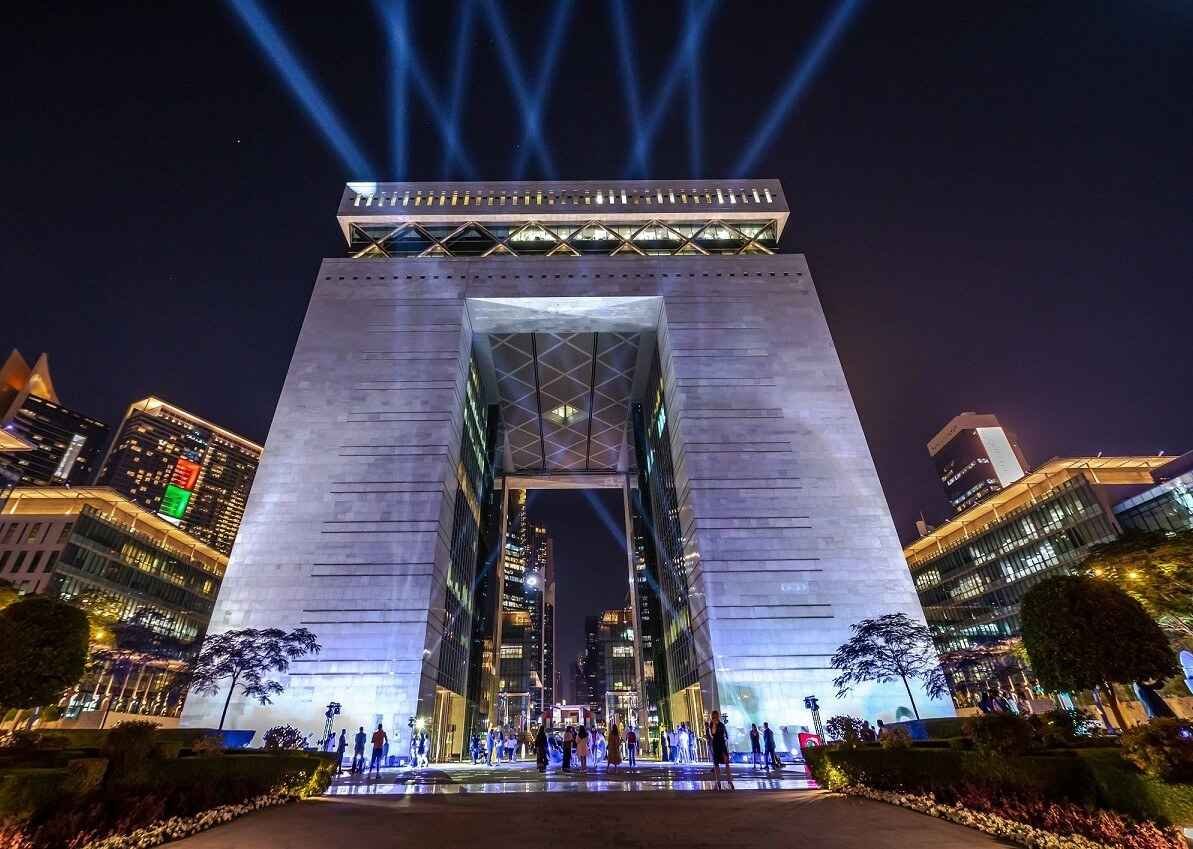

Dubai International Financial Centre – DIFC – is the one place in Dubai where a global bank’s regional headquarters, a Michelin-recognised restaurant, and a two-bedroom apartment with a Burj Khalifa view can sit inside the same three towers. It was built as a financial free zone. It has grown into one of the city’s most closely watched residential micro-markets.
This guide explains what DIFC actually is, how its residential market works in 2026, what it costs to buy or rent there, and who it genuinely suits – written for buyers, tenants, and investors who want facts rather than brochure language.
What Is DIFC?
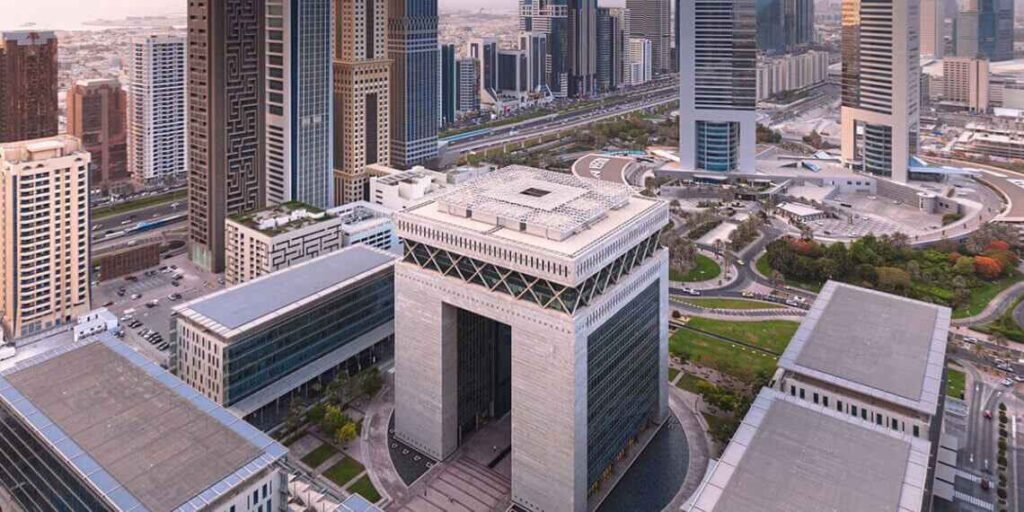
Dubai International Financial Centre is a 110-hectare mixed-use financial free zone in the heart of Dubai, established in 2004 by Sheikh Mohammed bin Rashid Al Maktoum. It functions as a self-contained jurisdiction with its own civil and commercial legal system based on English common law, overseen by an independent regulator, the Dubai Financial Services Authority (DFSA).
That legal distinction is the reason DIFC exists at all. Businesses registering here operate under a common-law framework rather than UAE civil law for commercial disputes, which is a significant draw for international banks, asset managers, and law firms. By the end of 2024, DIFC was home to roughly 6,920 registered companies, a 25% increase in a single year, spanning 260 banking institutions, over 400 wealth and asset management firms, and more than 125 insurance-related entities.
What matters for a homebuyer or tenant is that this business density created genuine residential demand. Thousands of professionals work inside DIFC every day, and a meaningful share of them want to live within walking distance of their office. That demand – not marketing – is what underpins DIFC’s apartment values.
DIFC Location, Connectivity & Getting Around
DIFC sits directly between Downtown Dubai and Trade Centre, bordering Sheikh Zayed Road, Dubai’s principal north-south artery. This positioning is arguably its single biggest asset.
From DIFC, Downtown Dubai and the Dubai Mall are roughly 10 minutes away by car, Dubai International Airport (DXB) is about 15 minutes, and Business Bay is a short drive along the same corridor. Sheikh Zayed Road access means the wider city – Marina, JLT, Al Barsha – is reachable without navigating side streets.
Public transport is a genuine strength here, unlike many premium Dubai communities. DIFC has two Dubai Metro stations within walking distance of different parts of the district: Financial Centre Metro Station and Emirates Towers Metro Station. Both sit on the Red Line, giving direct access to Downtown Dubai, Business Bay, Dubai Marina, and the airport corridor without a car. Within the district, DIFC is genuinely walkable – Gate Avenue links most residential and commercial towers under cover, which matters during Dubai’s hotter months.
History and the DIFC 2.0 Masterplan
DIFC opened in 2004 as a purpose-built financial zone anchored by The Gate Building, still the district’s most recognisable structure. For its first decade, the centre was almost entirely commercial – offices, banks, and a handful of hotel residences.
That changed as demand from employees for nearby housing grew faster than the original masterplan anticipated. In January 2019, DIFC announced an expansion of roughly 13 million square feet of additional space, known as DIFC 2.0, aimed at adding office, retail, and residential capacity. In January 2020, the Dubai Future District was launched, physically and strategically connecting DIFC with the Dubai World Trade Centre and Emirates Towers to form a combined hub for finance, technology, and the “new economy” that Dubai’s leadership has prioritised.
The practical result for residents: DIFC today is no longer just a business park with a few apartments bolted on. It is a district actively being redesigned around a live-work-play model, with new residential towers, retail, and public realm still under construction.
The Legal and Business Framework
For anyone considering an investment here, the legal structure is worth understanding, because it shapes both the commercial market and the confidence around residential values.
DIFC operates under an independent judicial system – the DIFC Courts – that applies English common law to civil and commercial matters within the zone, separate from Dubai’s wider civil law system. It is regulated by the DFSA, an independent financial services regulator modelled on frameworks used in London and Singapore. Companies registering in DIFC benefit from 100% foreign ownership, a 0% tax rate on income and profits guaranteed for 50 years, and full repatriation of capital and profits.
This is why DIFC hosts Fortune 500 names and global institutions rather than smaller regional operators, and why the residential population skews toward senior professionals, executives, and financiers with strong, stable incomes – a tenant profile landlords generally value.
Residential Property in DIFC
Residential supply inside DIFC is genuinely limited relative to its commercial footprint. Roughly 30% of DIFC’s land is allocated to residential and mixed-use towers, and only a portion of that has been built out so far, which is one reason new residential launches here tend to sell quickly.
Key residential towers
Index Tower is one of DIFC’s original landmark residential buildings, offering studios through to larger three-bedroom units with floor-to-ceiling glazing and skyline views. Central Park Towers and Sky Gardens are similarly established addresses combining apartments with amenity floors, gyms, and pools. Limestone House and Burj Daman round out the district’s earlier residential stock, both within a short walk of Gate Avenue.
DIFC Living, the district’s first purpose-built residential-only tower, marked a shift toward dedicated housing rather than mixed-use conversions. It comprises around 170 residences across 41 storeys, built to LEED sustainability standards, with a private cinema, co-working space, and an infinity pool. Units in this launch reportedly sold out within weeks, which is a fair indicator of pent-up demand for new DIFC stock specifically, rather than adjacent areas.
It’s worth flagging a common source of confusion in DIFC property searches: developments like Eden House and some towers along the Za’abeel side are marketed under a “DIFC” or “Zabeel 2” banner because they sit close to the district, but they are technically part of neighbouring Zabeel rather than inside the DIFC free zone boundary itself. If proximity to DIFC’s actual metro stations and Gate Avenue matters to you, confirm the exact plot location before committing, rather than relying on a listing’s area tag.
Property types available
DIFC’s residential mix runs from studios of roughly 500–600 square feet up to expansive three- and four-bedroom apartments and penthouses exceeding 1,800 square feet, several with duplex layouts. There are no standalone villas or townhouses in DIFC – the district is entirely high-rise – and commercial units (offices and Gate Avenue retail) exist alongside but are managed and leased separately from residential stock.
Off-plan versus ready
Ready stock is concentrated in the established towers listed above, generally offering faster occupancy and known service charges. Off-plan opportunities are more limited than in newer Dubai communities, simply because land is scarcer, but DIFC 2.0 is expected to bring further residential launches over the coming years as the masterplan is built out.
Prices, Rents and Rental Yield
Property values in DIFC sit in the mid-to-upper segment of Dubai’s residential market, reflecting its central location and limited supply. Based on recent Dubai Land Department-sourced transaction data, indicative price ranges look roughly like this:
Studio apartments trade from around AED 930,000 to just over AED 1.2 million depending on building and floor. One-bedroom units average close to AED 2.1 million in premium towers, though entry points can be lower in older stock. Two-bedroom apartments are typically priced near AED 3 million, and larger three-bedroom residences with Burj Khalifa or skyline views can exceed AED 6.8 million in the district’s best-positioned units. These figures vary meaningfully by tower, floor level, and view, so treat them as a starting reference rather than a firm quote for any specific unit.
On rents, DIFC consistently ranks among the highest-priced districts in Dubai for one- and two-bedroom apartments, alongside Downtown Dubai and Palm Jumeirah, driven by tenant demand from the professionals working inside the zone.
Rental yield is where expectations need to be realistic. DIFC behaves like a central business district rather than a mid-market suburb: high purchase prices compress percentage yield even when absolute rents are strong. Premium, centrally located Dubai communities such as DIFC and Downtown typically generate gross rental yields in the 4% to 6% range, compared with 7% to 9%-plus in more affordable, higher-supply communities like JVC or Dubai Silicon Oasis. Net yield – after service charges, void periods, and management costs – typically runs one to two percentage points below gross.
Service charges are a meaningful factor to underwrite here. Premium areas like DIFC commonly run AED 25 to 35 per square foot annually, well above mid-market communities’ AED 12 to 18. On a 1,000-square-foot apartment, that is an annual service charge bill of roughly AED 25,000 to 35,000, which should be built into any ROI calculation rather than treated as a footnote. The realistic investor case for DIFC is capital stability and tenant quality rather than the highest headline yield in the city – a trade-off, not a flaw, and one that suits a specific type of buyer better than others.
Lifestyle: Dining, Art, and Nightlife
DIFC has deliberately positioned itself as more than a nine-to-five district. Gate Village and Gate Avenue anchor the district’s dining and retail scene, home to a concentration of contemporary restaurants, Middle Eastern and Asian fusion concepts, and several Michelin-recognised establishments, alongside boutique fashion, wellness, and lifestyle retail.
The area has also become one of Dubai’s more credible art hubs, with galleries including Opera Gallery, Tabari Artspace, Sconci Gallery, and Andakulova Gallery hosting rotating exhibitions, supported by the recurring DIFC Art Nights open-air festival series. In the evenings, rooftop bars and lounges such as Alma Music & Art Lounge, BOCA, Galaxy Bar, and MINA Brasserie give the district a nightlife identity closer to a boutique urban neighbourhood than a corporate zone.
For broader retail and entertainment, residents are a short drive or metro ride from the Dubai Mall and Downtown Dubai’s wider attractions, including the Burj Khalifa and Dubai Fountain.
Families, Schools, and Healthcare
DIFC is best understood as a professional and investor district first, and a family district second. There are no schools physically located inside DIFC itself, so families typically rely on nearby options in Downtown Dubai, Zabeel, and Business Bay, which offer British and American curriculum schools within a short drive.
Healthcare access is convenient day-to-day: the district has a good density of pharmacies (including branches of Life Pharmacy, Supercare, and Medicina Pharmacy), and residents are close to hospitals and clinics in Downtown Dubai and Jumeirah for more comprehensive medical care. This profile – strong daily convenience, limited on-site schooling – makes DIFC a better fit for working professionals and couples than for large families prioritising walk-to-school living, which is a genuine consideration worth weighing honestly rather than glossing over.
Investment Case: Strengths and Realistic Risks
DIFC’s investment case rests on four pillars: an irreplaceable central location, freehold ownership open to foreign nationals, structurally high and resilient tenant demand from the businesses based there, and a genuinely constrained residential supply pipeline relative to commercial space.
The freehold status matters practically – DIFC grants full legal ownership to both UAE residents and foreign nationals, with title registered through the Dubai Land Department, the same framework used across Dubai’s other freehold communities. Liquidity has historically been strong; new residential launches in the district, including DIFC Living, have reportedly sold out within weeks of release, which reflects genuine scarcity rather than only marketing momentum.
The realistic risks are worth stating plainly rather than skipped. Entry prices are high relative to yield, meaning DIFC suits capital preservation and long-term appreciation strategies better than short-term cash-flow plays. Service charges in premium towers are materially higher than in mid-market Dubai communities and need to be modelled into any return calculation. And because residential supply is tied to the pace of the DIFC 2.0 masterplan, off-plan choice is currently narrower here than in newer, larger-scale Dubai communities – patience and building selection matter more than in high-supply areas.
How to Buy Property in DIFC
The purchase process for DIFC residential property follows Dubai’s standard freehold procedure, since transactions are still registered through the Dubai Land Department rather than a separate DIFC property registry.
In practice, that means: agreeing terms and signing a memorandum of understanding (Form F) with the seller, paying a deposit (commonly 10%), obtaining a No Objection Certificate from the developer or building management confirming no outstanding service charges, and completing transfer of title at the DLD trustee office, where a 4% transfer fee applies. For off-plan purchases in towers still under construction, payment follows the developer’s milestone-linked payment plan rather than this same-day transfer process. Mortgage financing is available to both residents and non-residents through UAE banks, typically requiring a larger down payment for non-resident buyers than for UAE residents.
Given DIFC’s mix of established resale towers and occasional new launches, working with an agency that tracks DLD transaction data specifically for DIFC – rather than citywide averages – makes a meaningful difference to negotiating from an informed position.
Frequently Asked Questions
Is DIFC a good place to invest in property?
DIFC suits investors prioritising capital stability, a central location, and strong tenant quality over the highest possible rental yield. Gross yields typically sit in the 4% to 6% range, lower than mid-market Dubai communities, but supported by resilient demand from the district’s professional workforce and constrained residential supply.
Can foreigners buy property in DIFC?
Yes. DIFC is a freehold zone, meaning both UAE nationals and foreign nationals can hold full legal title to residential property there, registered through the Dubai Land Department.
What is the average price of an apartment in DIFC?
Indicative 2026 ranges run from roughly AED 930,000 to 1.2 million for a studio, around AED 2.1 million for a one-bedroom, close to AED 3 million for a two-bedroom, and AED 6.8 million or more for larger three-bedroom units with prime views. Prices vary significantly by tower and floor.
What is the rental yield in DIFC?
Gross rental yields in DIFC typically range from about 4% to 6%, comparable to Downtown Dubai, reflecting high entry prices offset by consistently strong tenant demand. Net yield, after service charges and other costs, generally runs one to two percentage points lower.
Are there schools in DIFC?
No schools are located within DIFC itself. Families typically use British and American curriculum schools in nearby Downtown Dubai and Zabeel, both a short drive away.
How is DIFC connected to the rest of Dubai?
DIFC has two Dubai Metro stations – Financial Centre and Emirates Towers, both on the Red Line – plus direct access to Sheikh Zayed Road. Downtown Dubai is about 10 minutes away and Dubai International Airport around 15 minutes by car.
What residential towers are available in DIFC?
Established options include Index Tower, Central Park Towers, Limestone House, Sky Gardens, and Burj Daman, alongside the newer, residential-only DIFC Living. Nearby Zabeel developments are sometimes marketed under a DIFC label, so it’s worth confirming the exact plot location.
Is DIFC freehold or leasehold?
DIFC residential property is sold on a freehold basis, giving buyers full ownership rights rather than a fixed-term lease.
What are service charges like in DIFC?
Service charges in DIFC’s premium towers typically run AED 25 to 35 per square foot annually, higher than mid-market Dubai communities, and should be factored into any yield calculation.
Is DIFC suitable for families?
DIFC works well for working professionals and couples given its walkability, dining, and metro access, but the lack of on-site schools means most families with school-age children choose neighbouring communities instead, even while enjoying DIFC’s lifestyle amenities regularly.
What is DIFC 2.0?
DIFC 2.0 is a 2019-announced expansion adding roughly 13 million square feet of office, retail, and residential space, part of a broader plan connecting DIFC with the Dubai World Trade Centre and Emirates Towers under the Dubai Future District initiative.
Is DIFC only a business district, or can I actually live there?
DIFC is an active residential neighbourhood as well as a business hub. Thousands of residents live in its towers today, drawn by walkability to work, dining, art, and metro access, alongside the ongoing addition of dedicated residential buildings like DIFC Living.
How does DIFC compare to Downtown Dubai for property investment?
The two districts are closely comparable in price positioning and yield profile, both trading at premium valuations with gross yields around 4% to 6%. DIFC differentiates itself through its business-district identity and boutique art and dining scene, while Downtown offers larger-scale retail and entertainment anchored around the Burj Khalifa and Dubai Mall.
What is the difference between DIFC and Zabeel?
DIFC is a defined financial free zone with its own legal and regulatory framework, while Zabeel is a neighbouring residential district. Some Zabeel developments are marketed with DIFC in their name or description due to proximity, so buyers should verify whether a property is actually within the DIFC boundary or simply nearby.
Does DIFC have hotels and serviced residences?
Yes. The district includes premium hospitality properties such as the Ritz-Carlton DIFC and Four Seasons Hotel DIFC, some of which offer hotel-branded residences alongside standard residential towers.

Leave a Reply