
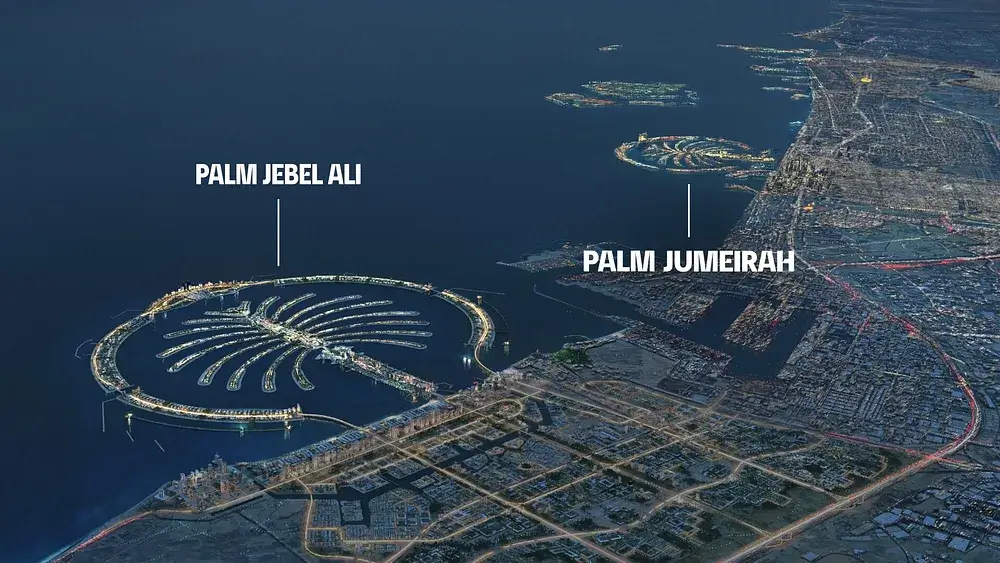

Jebel Ali is a large, multi-purpose district in southwest Dubai that combines the world’s largest man-made harbour, one of the region’s biggest free zones, and a growing set of residential communities – from gated villa neighbourhoods to the record-breaking Palm Jebel Ali island. If you’re weighing up whether to live, rent, or invest here in 2026, this guide breaks down exactly where Jebel Ali sits, what it’s made of, what it costs, and who it actually suits.
What and Where Is Jebel Ali?
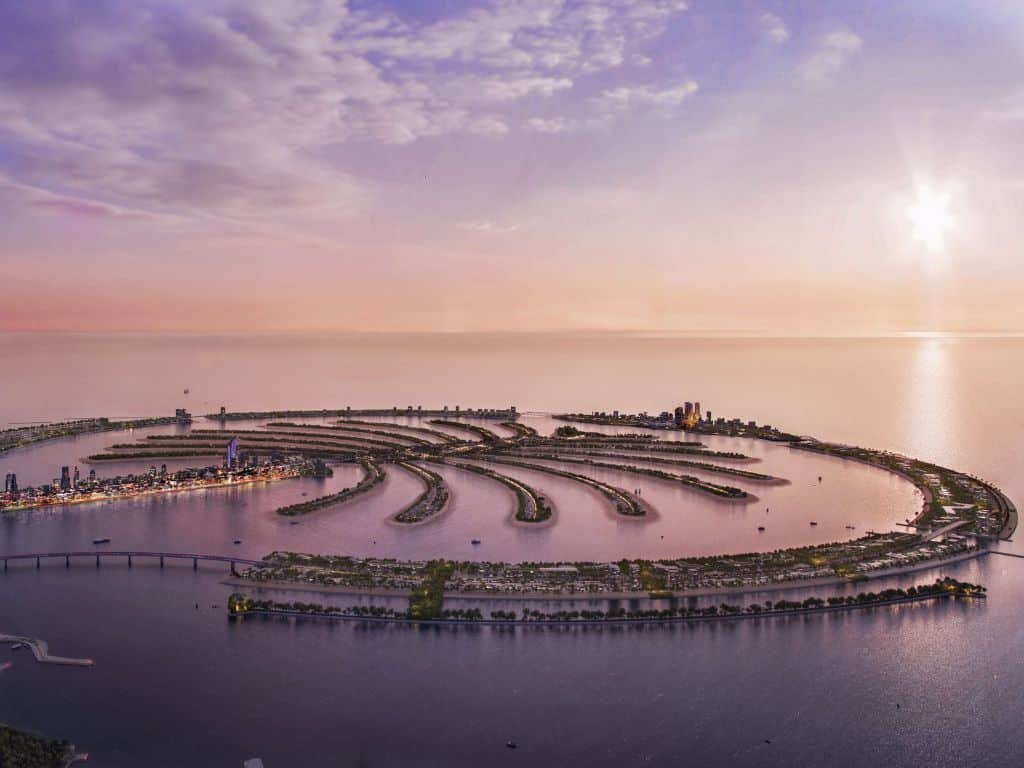
Jebel Ali is a coastal district on Dubai’s southwestern edge, roughly midway between Dubai Marina and the Abu Dhabi border, running along Sheikh Zayed Road (E11). The district covers close to 5 square kilometres of core residential and commercial land, though the wider Jebel Ali “catchment” – including the port, the free zone, and Palm Jebel Ali – extends much further along the coast.
Historically a fishing village, Jebel Ali grew into a global trade hub after the construction of Jebel Ali Port, now recognised as the largest man-made harbour in the world and one of the ten busiest container ports globally. That industrial identity still defines part of the district today, but it is only one layer of a much broader picture that now includes family villa communities, a fast-growing hillside neighbourhood, and Dubai’s second palm-shaped island.
Because “Jebel Ali” is used loosely to describe several different things, it helps to separate them clearly before going any further.
The Five Faces of Jebel Ali
Jebel Ali is not one neighbourhood – it’s an umbrella name covering five distinct zones, each with a different purpose, price point, and buyer profile.
Jebel Ali Port and the industrial belt. The commercial and logistics core, operated by DP World. This zone is not residential in the conventional sense; it hosts labour accommodation, warehouses, and shipping infrastructure, and it drives the employment demand that supports rental activity in the residential pockets nearby.
Jebel Ali Free Zone (JAFZA). A 57-square-kilometre free economic zone bordering Abu Dhabi, home to more than 7,000–9,700 international companies and over 130,000 employees across trade, logistics, and manufacturing. JAFZA alone is estimated to contribute around 23% of Dubai’s GDP, and its workforce is the single biggest structural driver of rental demand across Jebel Ali’s residential pockets.
Jebel Ali Village. Nakheel’s established, low-density gated villa and townhouse community, built on a hillside setting that gives it unusual natural elevation for Dubai’s otherwise flat western corridor. It consists entirely of villas and townhouses – there are no apartments here – and it has been substantially redeveloped and expanded over the past few years.
Downtown Jebel Ali and Jebel Ali Hills. Newer, apartment- and plot-led developments closer to Sheikh Zayed Road, positioned as the entry-level and mid-market layer of the district, with direct Red Line Metro access and JAFZA adjacency.
Palm Jebel Ali. Nakheel’s second palm-shaped island, roughly twice the size of Palm Jumeirah, now in active, contract-backed construction after more than a decade dormant. It sits under the same “Jebel Ali” geographic umbrella but functions as its own master-planned destination.
Understanding which of these five you actually mean is the single most useful step before searching for property, because pricing, lifestyle, and investment logic differ sharply between them.
Getting Around: Connectivity and Transport
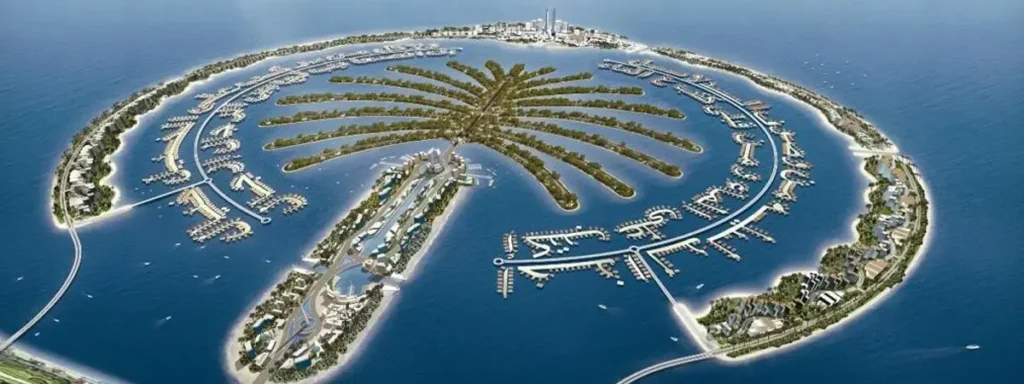
Jebel Ali is genuinely well connected for a district on Dubai’s edge, and that connectivity is one of its strongest investment arguments.
The district sits directly on Sheikh Zayed Road (E11), giving fast car access to Dubai Marina (around 15–20 minutes), Downtown Dubai, and onward to Abu Dhabi. The Dubai Metro Red Line runs through the area with several stations – Jebel Ali Metro Station, Ibn Battuta Metro Station, Energy Metro Station, and Danube Metro Station among them. Jebel Ali Metro Station is also the first stop on the Route 2020 extension, which continues to Expo City Dubai and on to Al Furjan, making the district one of only a handful in Dubai with two-line metro access. RTA bus routes, including the F54 service linking Ibn Battuta and Jebel Ali, fill in the gaps between metro stations and residential clusters.
For residents commuting to JAFZA, Jebel Ali Port, or the fast-expanding Al Maktoum International Airport and Dubai South employment zone just south of the district, this is one of the shortest commutes available anywhere in Dubai – a point that matters more to long-term tenant demand than any amenity list.
Lifestyle: Shopping, Dining, Beaches and Recreation
Daily life in Jebel Ali revolves around a handful of well-established hubs rather than a single walkable town centre, so most residents rely on a short drive for shopping and leisure.
Ibn Battuta Mall, one of the world’s largest themed shopping centres, sits a few minutes from Jebel Ali Village and offers six travel-themed courts, an IMAX cinema, Sky Zone, Fun City, and a wide mix of international retail and dining brands. Festival Plaza Mall, roughly ten minutes away, is a more everyday destination with IKEA, LuLu Hypermarket, and mainstream fashion outlets. For families who prefer a beach day over a mall trip, Jebel Ali Beach offers a quieter, less crowded stretch of Arabian Gulf coastline than JBR or Dubai Marina, while hotel-operated beaches at JA Beach Hotel and JA Palm Tree Court provide resort-style leisure, watersports, and golf through the Jebel Ali Golf Resort.
The Jebel Ali Recreation Club, run by Nakheel, functions as the social centrepiece for Jebel Ali Village residents, combining a pool, sports courts, dining, and a genuine community events calendar. A short drive further along Sheikh Zayed Road brings residents to Dubai Parks and Resorts (Motiongate, Legoland, Bollywood Parks) and The Outlet Village, a Tuscan-themed discount luxury retail destination. Jebel Ali is also home to one of the region’s most significant multi-faith religious complexes, the Jebel Ali Churches Complex, alongside mosques and one of the UAE’s largest Sikh temples.
Schools, Healthcare and Everyday Amenities
Families considering Jebel Ali should note that most established schooling and healthcare options sit just outside the immediate district, in neighbouring Discovery Gardens, Al Furjan, and Jumeirah Village clusters, with a short commute required for the newest sub-communities. Within the district itself, clinics such as Aster Clinic, Access Clinic, and several polyclinics in JAFZA and the industrial area cover routine healthcare needs, while Nesto, Carrefour, and LuLu hypermarkets, along with numerous smaller supermarkets across the industrial and residential zones, handle day-to-day groceries. Downtown Jebel Ali and the newer apartment towers currently have limited dedicated schooling on-site, which is worth factoring in if you’re buying primarily for family use rather than rental yield.
Property Types and What You’ll Actually Pay in 2026
Jebel Ali’s property market spans a wider range than almost any other Dubai district, from budget studios in the industrial belt to multimillion-dirham waterfront villas on Palm Jebel Ali. Here’s how the numbers break down by zone.
Apartments across the district generally range from around AED 1,500 to AED 2,000 per square foot, with entry-level studios starting from roughly AED 250,000–450,000 and larger three-bedroom units reaching AED 2–3.5 million depending on building quality and metro proximity. Average asking prices across the broader Jebel Ali listing pool sit around AED 1.7–1.8 million.
Jebel Ali Village, now firmly established as the district’s premium gated villa community, has seen sharp appreciation. Three-bedroom townhouses currently trade between roughly AED 4.4 million and AED 5.5 million, four-bedroom townhouses between AED 5.8 million and AED 7.5 million, four-bedroom independent villas between AED 9.2 million and AED 10.8 million, and five-bedroom villas from AED 11 million upward, with premium park-facing units reaching AED 13–15.5 million. Some of the strongest-performing clusters within the village have moved from roughly AED 1,240 per square foot in earlier transactions to over AED 2,700 per square foot in 2026 sales – appreciation of well over 100% in under two years, driven largely by the current 2025–2026 handover window.
Jebel Ali Hills offers freehold residential plots for buyers who want to build, typically around 10,000 square feet, priced from roughly AED 3.4 million to AED 4.8 million, alongside completed villas averaging around AED 3.7 million.
Downtown Jebel Ali and the newer Jabal Ali First apartment cluster sit at the affordable end of the freehold market, pricing around AED 550–1,050 per square foot – comparable to early-stage Dubai South pricing – and are aimed squarely at yield-focused investors targeting the JAFZA and airport workforce rather than lifestyle buyers.
Palm Jebel Ali is the district’s ultra-prime layer. Off-plan villas in the Beach and Coral Collections currently start from around AED 18 million for five-bedroom units, rising to AED 21.5 million for six-bedroom villas and AED 29–43 million for premium seven-bedroom waterfront homes – broadly 60% below comparable per-square-foot pricing on Palm Jumeirah. Most projects follow an 80/20 payment structure, with the majority paid during construction and the balance on handover.
Palm Jebel Ali: Construction Status in 2026
Because Palm Jebel Ali carries such weight in the district’s investment story, it’s worth being precise about where the project actually stands rather than relying on marketing language.
As of mid-2026, Palm Jebel Ali has moved decisively from a revived masterplan into active, contract-backed construction. In April 2026, Nakheel awarded contracts worth more than AED 3.5 billion to build 544 villas: Ginco General Contracting is delivering 354 villas across Fronds A to D, while UNEC is building 190 villas across Fronds E and F, with completion targeted for Q4 2028. This adds to an earlier AED 5 billion contract package covering 723 Beach and Coral Collection villas across Fronds K to P, where Nakheel’s own construction-progress reporting (based on a March 2026 inspection) shows overall progress of roughly 26.75%, with individual fronds ranging from about 20.5% to 37.4% complete, and workstream progress of roughly 93% on substructure, 68% on superstructure, and 65% on infrastructure.
In February 2026, Aldar Properties and Dubai Holding also expanded their joint venture to include a luxury waterfront plot on Palm Jebel Ali as part of a wider AED 38 billion-plus development programme, broadening the island beyond a single-developer story. Early frond collections are citing handover dates around Q3–Q4 2027, though full island-wide buildout – all fronds, hospitality, and community infrastructure – realistically extends into the early 2030s. The practical takeaway for buyers: treat early handover dates as targets tied to specific contract packages, not a completion date for the island as a whole, and separate marketing claims from Nakheel’s published, frond-by-frond progress data before committing.
Investment Outlook and Rental Yields
Jebel Ali’s investment case rests on a fundamental that’s easy to overlook amid the Palm Jebel Ali headlines: this is one of the few Dubai districts where rental demand is driven by structural employment rather than lifestyle appeal alone. JAFZA’s workforce of well over 100,000 employees, combined with Jebel Ali Port operations and the fast-growing Dubai South and Al Maktoum Airport employment base to the south, creates a tenant pool that is largely independent of Dubai’s broader tourism and lifestyle cycles.
That translates into some of the strongest gross rental yields in Dubai for mid-market product. Studio and one-bedroom apartments near the Jebel Ali and JAFZA metro corridor typically deliver gross yields in the 8–11% range, with average yields across the wider district reported around 9–9.5%, outperforming most central Dubai communities. Newer, less-established pockets such as Downtown Jebel Ali currently project 7–9% gross yields, based on comparable JAFZA-corridor rents, though with less transaction history to confirm actual achieved rents at completion. At the other end of the market, Palm Jebel Ali functions as a capital-appreciation play rather than a yield play: gross rental yields on completed villa communities elsewhere on the Palm are currently modest (low single digits), and the investment case there is built on long-term value growth from a still-scarce new coastal supply, not short-term rental income.
Before committing capital, it’s worth running the numbers net of service charges – typically AED 8–14 per square foot annually for mid-market Jebel Ali buildings – and a realistic vacancy allowance, particularly for newer buildings still building tenant awareness. Properties above the AED 2 million threshold, common across Jebel Ali Village and Palm Jebel Ali, can also qualify buyers for the UAE Golden Visa, subject to current eligibility rules – a meaningful secondary benefit for investors structuring a long-term Dubai base alongside the purchase.
Who Jebel Ali Actually Suits
Jebel Ali works well for logistics, trade, and shipping professionals who want to cut their commute to JAFZA or the port to a few minutes rather than an hour across the city, and for investors prioritising yield stability over lifestyle prestige. It also suits families who want genuine space – larger plots, private gardens, lower density – at prices well below equivalent product in Arabian Ranches or Dubai Hills Estate, provided they’re comfortable being a drive rather than a walk from central Dubai’s retail and dining scene.
It’s a weaker fit for buyers who need to be in Downtown Dubai or DIFC daily without a metro commute, or for anyone chasing short-term holiday-let income, since Jebel Ali’s tenant base skews toward long-term residential contracts rather than tourism. For prime waterfront capital appreciation specifically, Palm Jebel Ali is a long-horizon, contract-backed but still-under-construction proposition – appropriate for patient capital, not a quick resale strategy.
Buying Process: What to Expect
Freehold ownership is available to both UAE nationals and international buyers in designated areas of Jebel Ali, including Jebel Ali Village, Jebel Ali Hills, Downtown Jebel Ali, and Palm Jebel Ali – always confirm the specific building or plot’s freehold status with the Dubai Land Department (DLD) before signing, since not every parcel within the wider Jebel Ali area carries freehold title. For off-plan purchases, buyers typically pay a reservation deposit followed by a staged payment plan (commonly structured around an 80/20 or similar split between construction milestones and handover) directly to the developer, with funds protected through a DLD-regulated escrow account.
For ready properties, the standard process involves a signed Memorandum of Understanding, a deposit (typically 10%), a No Objection Certificate from the developer, and final transfer at a DLD registration trustee office, alongside the standard 4% DLD transfer fee. Working with a RERA-registered broker who can pull actual DLD transaction data for the specific building or cluster – rather than relying on asking-price averages – is the single best way to avoid overpaying in a fast-appreciating pocket like Jebel Ali Village.
FAQs
Where exactly is Jebel Ali located in Dubai?
Jebel Ali is a district in southwest Dubai, along Sheikh Zayed Road, roughly between Dubai Marina and the Abu Dhabi border. It borders Dubai South and Al Furjan and includes Jebel Ali Port, JAFZA, several residential sub-communities, and Palm Jebel Ali.
Is Jebel Ali a freehold area?
Parts of it are. Jebel Ali Village, Jebel Ali Hills, Downtown Jebel Ali, and Palm Jebel Ali all include freehold-designated property available to international buyers, but not every parcel in the wider Jebel Ali area carries freehold title, so this should always be confirmed with the DLD for the specific unit.
What is JAFZA and how is it different from residential Jebel Ali?
JAFZA (Jebel Ali Free Zone) is a 57-square-kilometre business and industrial free zone hosting thousands of international companies. It is the employment engine behind much of Jebel Ali’s rental demand, but it is a commercial/industrial zone, distinct from the residential communities like Jebel Ali Village.
Is Jebel Ali a good place to live for families?
It suits families who prioritise space, privacy, and value over walkable central-Dubai convenience. Jebel Ali Village in particular offers low-density villa living with a community club, but schooling and some amenities require a short drive to neighbouring districts.
How far is Jebel Ali from Dubai Marina and Downtown Dubai?
Around 15–20 minutes by car to Dubai Marina, and roughly 25–35 minutes to Downtown Dubai, depending on traffic on Sheikh Zayed Road. The Red Line metro covers the same route without a car.
What is the average rental yield in Jebel Ali?
Mid-market apartments near the metro corridor typically deliver gross yields of around 8–11%, among the strongest in Dubai, driven by structural demand from the JAFZA and Jebel Ali Port workforce. Palm Jebel Ali, by contrast, currently offers modest yields and is better suited to capital appreciation.
Is Palm Jebel Ali ready to move into?
Not yet, as of 2026. The project is in active, contract-backed construction, with Nakheel’s official progress data showing roughly 27% overall progress on the earlier villa fronds and initial handovers targeted from late 2026 into 2027–2028 depending on the specific frond and collection.
How does Jebel Ali compare to Dubai South for investment?
Both are southern-corridor, JAFZA/airport-linked growth areas with similar entry pricing. Jebel Ali has the advantage of existing, operational metro access and an established employment base right now; Dubai South’s growth is more closely tied to the phased, longer-term expansion of Al Maktoum International Airport.
What property types are available in Jebel Ali?
The district spans studios and apartments, townhouses, independent villas, freehold building plots (in Jebel Ali Hills), and waterfront villas on Palm Jebel Ali, plus commercial and industrial space within JAFZA.
Does Jebel Ali have metro access?
Yes. The district is served by the Dubai Metro Red Line, including Jebel Ali, Ibn Battuta, Energy, and Danube stations, and Jebel Ali Metro Station is also the first stop on the Route 2020 extension toward Expo City Dubai and Al Furjan.
What is the price range for apartments in Jebel Ali?
Roughly AED 1,500–2,000 per square foot on average, with studios starting from around AED 250,000–450,000 and larger units reaching AED 2–3.5 million, depending on the building and its proximity to the metro.
Are there schools and hospitals within Jebel Ali itself?
Coverage is limited within the newest sub-communities; most established schools and larger hospitals sit in neighbouring Discovery Gardens, Al Furjan, and Jumeirah Village clusters, a short drive from central Jebel Ali.
Can I get a UAE Golden Visa by buying property in Jebel Ali?
Properties priced above AED 2 million, which cover most of Jebel Ali Village and Palm Jebel Ali, can qualify buyers for the UAE’s Golden Visa programme, subject to the current eligibility criteria at the time of purchase.
What is the difference between Jebel Ali Village and Jebel Ali Hills?
Jebel Ali Village is an established, fully built-out gated villa and townhouse community. Jebel Ali Hills is a newer, plot-led development offering freehold land for buyers who want to build their own villa, alongside a smaller stock of completed homes.
Is now a good time to invest in Jebel Ali?
Jebel Ali currently combines operational infrastructure (metro, highways, an established workforce) with ongoing price appreciation in its established sub-communities and a still-scarce new-supply story on Palm Jebel Ali. As with any Dubai purchase, the right entry point depends on your goals — yield, appreciation, or lifestyle — and should be checked against current DLD transaction data for the specific building or cluster rather than area-wide averages.

Leave a Reply