
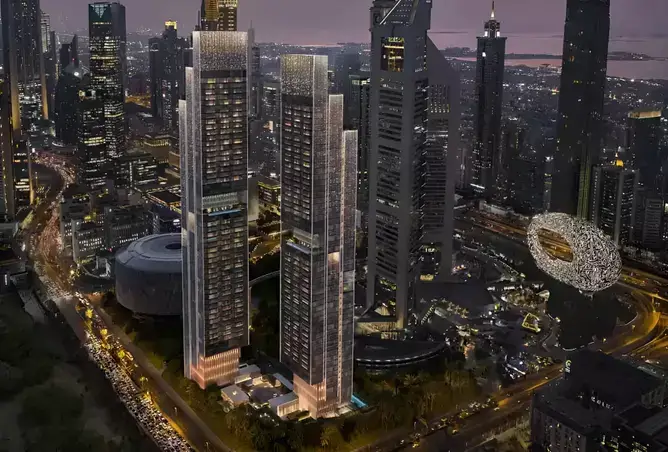

Emirates Towers is one of Dubai’s most recognisable addresses – a twin-tower landmark on Sheikh Zayed Road that has quietly evolved from a pure business icon into one of the city’s most closely watched residential investment locations. This guide explains exactly what Emirates Towers is, where it sits within Dubai, what it’s like to live or work there, and what buyers and tenants should know before committing money to the area in 2026.
What Is Emirates Towers?
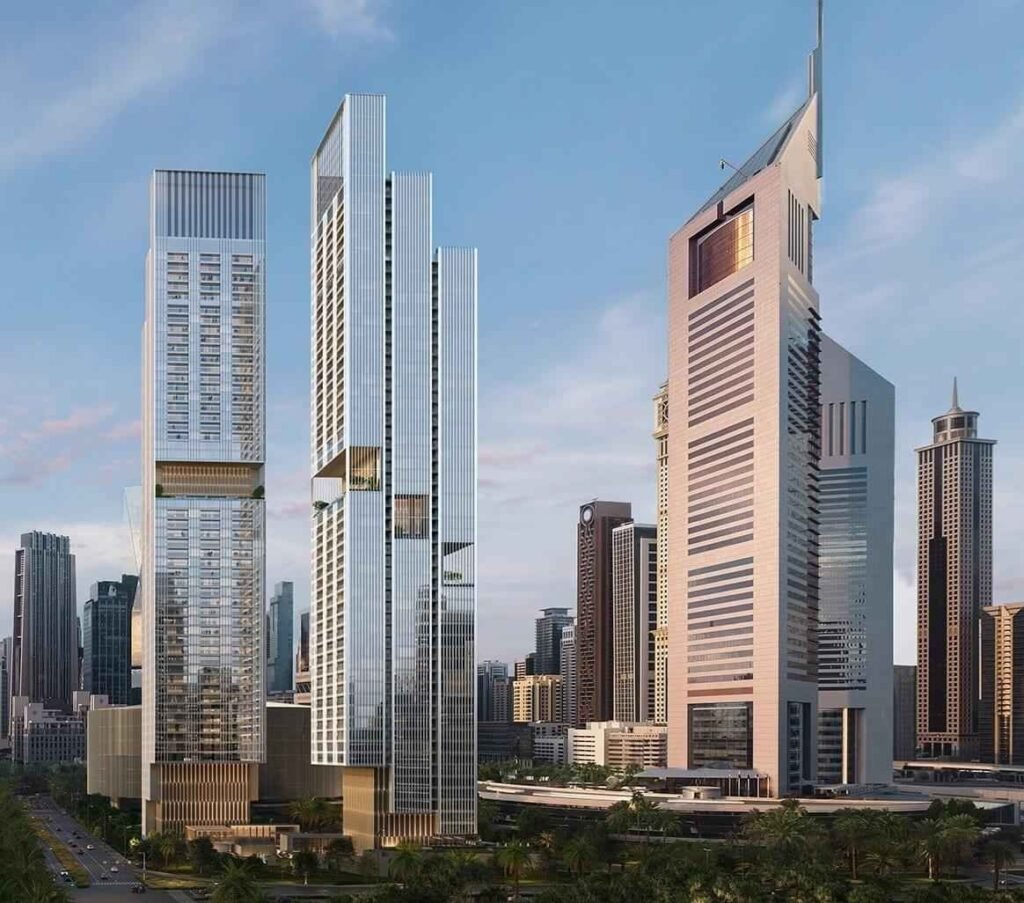
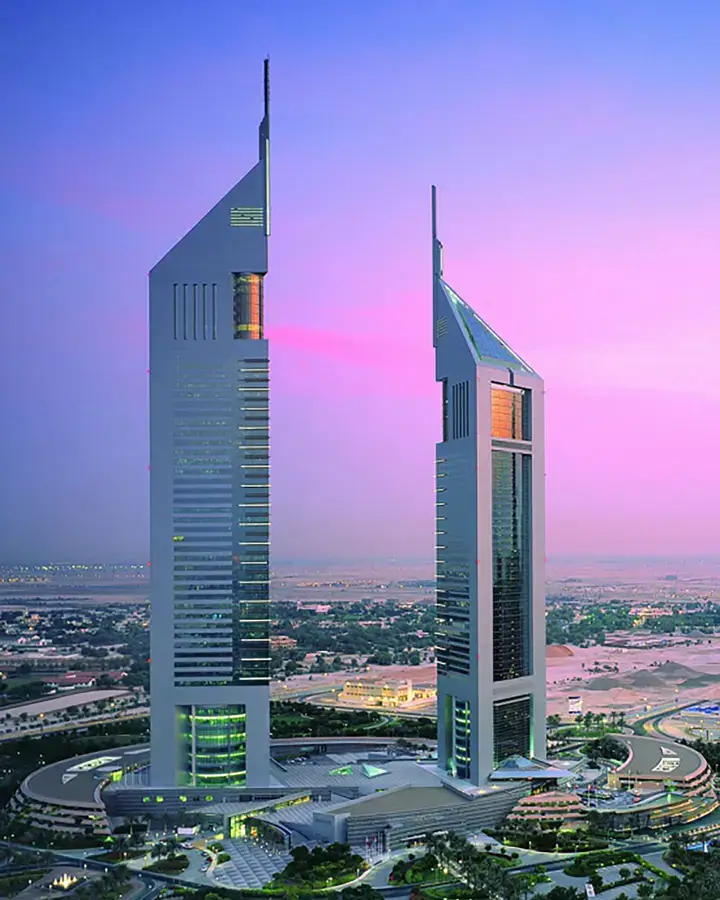
Emirates Towers is a landmark twin-tower complex on Sheikh Zayed Road, comprising the Emirates Office Tower and the Jumeirah Emirates Towers Hotel, connected by a two-storey retail podium known as The Boulevard. The office tower rises to roughly 355 metres, while the hotel tower reaches around 305 metres – for a period after their completion in 2000, they were the tallest buildings in Dubai.
The project came out of an international design competition commissioned in the mid-1990s by His Highness Sheikh Mohammed bin Rashid Al Maktoum, and construction ran from 1997 to 2000. Hong Kong-based architect Hazel Wong, working with NORR Group Consultants, designed the two triangular towers to echo a recurring theme in the emirate’s architecture – earth, sun and moon. The complex sits within more than 570,000 square metres of landscaped gardens, lakes and waterfalls, and is one of the few places in central Dubai where peacocks from the neighbouring Zabeel Palace still roam freely.
Importantly, “Emirates Towers” today refers to more than the original two buildings. Since 2020 it has anchored the Dubai Future District, a corridor that formally links Emirates Towers, the Dubai World Trade Centre and DIFC into a single innovation and finance hub. And since the 2020s, a new residential chapter has opened with Jumeirah Residences Emirates Towers, a branded apartment development by Meraas and Jumeirah rising on the same site – which is why “Emirates Towers” now shows up in both office-leasing searches and Dubai apartment-buying searches.
Where Is Emirates Towers Located?
Emirates Towers sits directly on Sheikh Zayed Road, Dubai’s principal north–south expressway, within the Trade Centre Second district in the Za’abeel area of the city. This puts it almost exactly between two of Dubai’s biggest employment and lifestyle hubs: the Dubai International Financial Centre (DIFC) sits immediately to one side, connected by an indoor walkway through Gate Avenue, while Downtown Dubai – home to the Burj Khalifa, Dubai Mall and Dubai Fountain – is a short drive or metro ride away.
Za’abeel Park and the Dubai Frame are close by to the north, and the Museum of the Future is directly across the road, linked to the Emirates Towers Metro Station by a dedicated pedestrian bridge. Dubai International Airport (DXB) is roughly a 14-minute drive, and Al Maktoum International Airport (DWC) is around 47 minutes away in typical traffic – useful reference points for both business tenants and investors thinking about tenant demand.
Getting Around: Metro, Roads, and Connectivity
Public transport access is one of the strongest arguments for Emirates Towers as a location. The Emirates Towers Metro Station, on the Dubai Metro Red Line, opened in April 2010 and sits on a viaduct on the eastern side of Sheikh Zayed Road, directly beside the towers. It falls in Fare Zone 6 and is one stop from Financial Centre station and one stop from World Trade Centre station, giving residents and office workers a direct, traffic-free run to Downtown Dubai, Dubai Marina, Business Bay and DXB Terminal 1 & 3.
Beyond the metro, the location benefits from direct access onto Sheikh Zayed Road itself, plus Al Khail Road nearby, making car journeys to almost anywhere in the city straightforward outside peak hours. Feeder buses, taxis, and ride-hailing apps such as Uber and Careem are all readily available at street level, and the area is comfortably walkable between the towers, DIFC’s Gate Avenue, and the Museum of the Future – a genuine advantage in a city where many communities are car-dependent.
Inside the Complex: Offices, Hotel, and Retail
The Emirates Office Tower is a Grade A commercial building of around 54–56 storeys, historically home to government-linked entities, financial institutions, and multinational corporates drawn to a globally recognised business address. The Jumeirah Emirates Towers Hotel, in the second tower, is a five-star property with around 400 rooms, an atrium rising more than 30 floors, and a well-known collection of restaurants and bars that made the complex a Dubai social landmark long before Downtown Dubai existed.
Linking the two towers is The Boulevard, a two-storey, roughly 9,000-square-metre retail and dining strip. It’s smaller and more understated than a shopping mall like Dubai Mall or Mall of the Emirates, functioning more as a curated business-district amenity – cafés, restaurants, salons and services aimed at office tenants, hotel guests and, increasingly, residents of the new towers.
Lifestyle: What It’s Actually Like Around Emirates Towers
Emirates Towers reads as a business-district lifestyle, not a suburban or beach-community one, and that distinction matters for anyone deciding whether to live here. Days revolve around a short walk between the office tower, DIFC’s restaurant and nightlife scene at Gate Avenue, and hotel dining at Jumeirah Emirates Towers or the neighbouring Shangri-La. Evenings and weekends draw residents toward Downtown Dubai’s Dubai Fountain, Dubai Opera, and Dubai Mall, or to Za’abeel Park for green space and the Dubai Frame.
It’s a highly walkable, well-lit, security-conscious environment that suits professionals, couples and singles who want to be at the centre of the city with minimal commute – but it is not, today, a natural fit for families seeking villa-style space, private gardens, or a dense cluster of nurseries and schools on the doorstep. Families based here typically use schools in nearby Downtown Dubai, Jumeirah, and Al Wasl, and healthcare needs are covered by hospitals a short drive away in Bur Dubai and Al Satwa. Pet owners will find Za’abeel Park a practical nearby option for walks, though the immediate towers footprint itself is more paved plaza than green residential garden.
Residential Real Estate: Jumeirah Residences Emirates Towers
The biggest shift in the Emirates Towers story for property buyers is the arrival of Jumeirah Residences Emirates Towers, a branded residential development by Meraas in partnership with Jumeirah Group, built on the same landmark site. It comprises two residential towers – Tower A and Tower B, with one reaching around 57 storeys – offering one- to four-bedroom apartments, plus three-bedroom duplex layouts, finished with Jumeirah’s five-star service standard rather than a typical developer handover.
As of the current sales phase, indicative starting prices are approximately:
- 1-bedroom apartments (around 861–898 sq ft) from about AED 3.5 million
- 2-bedroom apartments (around 1,112–1,590 sq ft) from about AED 4.8 million
- 3-bedroom apartments (around 1,925–2,557 sq ft) from about AED 10–10.2 million
- 4-bedroom apartments (around 3,467–6,369 sq ft) from about AED 25 million
These are launch/entry prices and will vary by floor, view, and release phase – always confirm current pricing directly, since off-plan pricing in a landmark project like this tends to move quickly as construction milestones pass. Handover is currently targeted around Q3 2030. Amenities span sky pools, an adults-only infinity pool, private dining rooms, a co-working lounge, a cinema, a padel court, a wellness spa, and Jumeirah’s signature concierge and housekeeping services – positioning the project firmly in Dubai’s ultra-luxury, branded-residence segment alongside addresses like Bulgari Residences or One Za’abeel.
Because units here are priced at or above the AED 2 million threshold, they qualify buyers for the UAE’s 10-year Golden Visa, which is a meaningful consideration for international investors alongside the tax-free rental income that Dubai property is generally known for.
Commercial Real Estate: Offices at Emirates Towers
For businesses, the Emirates Office Tower remains one of Dubai’s prestige commercial addresses, offering full-floor and part-floor Grade A office space with the credibility of a globally recognised skyline landmark. Occupiers value the direct Sheikh Zayed Road frontage, the metro-linked accessibility for staff and clients, and the proximity to DIFC for companies that need a finance-district presence without paying strictly DIFC-zone rates. Retail units within The Boulevard suit food and beverage or service brands targeting a steady footfall of office workers and hotel guests rather than high street shopping traffic.
Rental Trends and Investment Potential
Sheikh Zayed Road, of which Emirates Towers is a flagship address, commands some of Dubai’s highest rents outside the very newest luxury towers. As a benchmark, two-bedroom apartments along this stretch have recently averaged around AED 182,000 per year, with premium, view-facing or newly delivered units commanding more. Estimated rental yields for well-positioned units in this corridor typically sit in the region of 5–7%, which is broadly in line with prime central Dubai but can be pushed higher for smaller, efficiently priced units aimed at DIFC and financial-sector tenants.
Resale and off-plan asking prices for Jumeirah Residences Emirates Towers have moved up sharply since launch, reflecting strong early demand for a rare branded, Jumeirah-serviced address in this specific location – a pattern typical of high-profile Meraas launches. For investors, the practical takeaway is that Emirates Towers suits a capital-growth-plus-rental-income strategy aimed at high-earning professional and corporate tenants, rather than a high-volume, budget rental play. Buyers should weigh unit size against typical tenant demand: one- and two-bedroom units tend to see the deepest pool of professional tenants working in DIFC, Downtown Dubai and along the Sheikh Zayed Road corridor.
Buying Process: What to Expect
Buying at Emirates Towers follows Dubai’s standard freehold purchase process, since the residential towers sit on freehold land available to both UAE nationals and foreign investors. For off-plan units, buyers typically reserve with a booking fee, sign a Sales and Purchase Agreement (SPA) with the developer, and follow a staged payment plan tied to construction milestones through to handover. For ready or resale units, the process runs through the Dubai Land Department (DLD), usually involving a Memorandum of Understanding, an No Objection Certificate (NOC) from the developer, and final transfer at a DLD registration trustee office, alongside the standard 4% DLD transfer fee.
As with any landmark or branded-residence purchase in Dubai, it’s worth having an independent lawyer or licensed broker review the SPA and payment schedule before committing, and to verify current pricing and availability directly with the developer or a registered agent, since off-plan phases and prices change frequently.
Frequently Asked Questions
Where is Emirates Towers located in Dubai?
Emirates Towers sits directly on Sheikh Zayed Road in the Trade Centre Second area of Za’abeel, between DIFC and Downtown Dubai, roughly a 14-minute drive from Dubai International Airport.
What is inside Emirates Towers?
The complex contains the Emirates Office Tower (Grade A commercial space), the five-star Jumeirah Emirates Towers Hotel, and The Boulevard, a two-storey retail and dining strip connecting the two towers.
Who developed Emirates Towers?
The original twin towers were built for Sheikh Mohammed bin Rashid Al Maktoum, with construction carried out by Al Ghurair Investment Group and architectural design led by Hazel Wong and NORR Group, completed in 2000. The newer residential development, Jumeirah Residences Emirates Towers, is being built by Meraas in partnership with Jumeirah Group.
Is Emirates Towers the same as Jumeirah Residences Emirates Towers?
No. Emirates Towers refers to the original 2000-era office and hotel complex. Jumeirah Residences Emirates Towers is a separate, newer branded residential project on the same site, offering apartments for sale rather than office or hotel space.
How do I get to Emirates Towers by metro?
The Emirates Towers Metro Station on the Dubai Metro Red Line sits directly beside the complex, one stop from Financial Centre station and one stop from World Trade Centre station, with a pedestrian bridge across to the Museum of the Future.
Is Emirates Towers a good place to invest in property?
It suits investors targeting capital growth and premium rental income from professional and corporate tenants, thanks to its DIFC-adjacent location and metro access, rather than investors seeking high rental yields from budget or family housing.
What are current prices at Jumeirah Residences Emirates Towers?
Entry prices currently start from around AED 3.5 million for a one-bedroom apartment and around AED 4.8 million for a two-bedroom apartment, rising toward AED 25 million for a four-bedroom residence, though prices move with each release phase and should be confirmed directly.
What is the average rent near Emirates Towers?
Two-bedroom apartments along the Sheikh Zayed Road corridor, where Emirates Towers sits, have recently averaged around AED 182,000 per year, with estimated yields broadly in the 5–7% range.
Is Emirates Towers close to Downtown Dubai and Burj Khalifa?
Yes — Downtown Dubai is a short metro ride or drive away, making Burj Khalifa, Dubai Mall and Dubai Fountain easily accessible from Emirates Towers.
Is Emirates Towers a family-friendly area?
It functions primarily as a business and hospitality district. It suits professionals and couples well, but families often look to nearby areas such as Downtown Dubai, Jumeirah or Al Wasl for schools and family-oriented amenities.
Does buying at Jumeirah Residences Emirates Towers qualify for a UAE Golden Visa?
Yes, units priced at or above AED 2 million qualify eligible buyers for the UAE’s 10-year Golden Visa, subject to standard immigration requirements.
How far is Emirates Towers from Dubai International Airport?
Around a 14-minute drive from DXB in typical traffic, and roughly 47 minutes from Al Maktoum International Airport (DWC).
Can foreigners buy property at Emirates Towers?
Yes, the residential towers are on freehold land, meaning both UAE nationals and foreign investors can buy, sell, and register ownership through the Dubai Land Department.
What was Emirates Towers before the new residential project?
For its first two decades, Emirates Towers was known purely as a commercial and hospitality landmark – the Emirates Office Tower and the Jumeirah Emirates Towers Hotel – before Meraas and Jumeirah added the residential towers.
Is Emirates Towers still one of Dubai’s tallest buildings?
It was Dubai’s tallest complex for a period after completion in 2000, and remains among the city’s most recognisable skyline landmarks, though it has since been surpassed in height by newer towers, including the Burj Khalifa.

Leave a Reply