
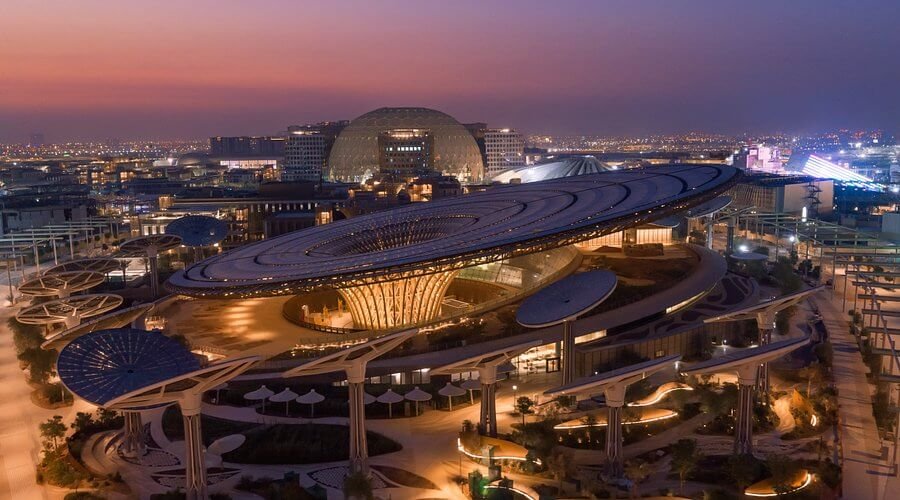

Expo City Dubai is the permanent, mixed-use city that grew out of the Expo 2020 Dubai World Fair site. It sits inside Dubai South, close to Al Maktoum International Airport, and it is being developed by Expo City Dubai (formerly Expo 2020 Dubai’s operating authority, now aligned with DP World) into a residential, commercial and cultural district built around a “15-minute city” concept – meaning most daily needs are meant to be reachable on foot, by bike, or by a short ride within the community.
For homebuyers and investors, Expo City Dubai in 2026 is best understood as an early-stage freehold community: a handful of residential clusters are selling off-plan or newly handed over, the metro and main roads are already operating, and the surrounding social infrastructure – schools, hospitals, retail – is still catching up. This guide walks through the location, the master plan, what it’s like to live there today, the residential options on the market, realistic price and yield figures, and the practical buying process, so you can judge for yourself whether it fits your goals.
What Is Expo City Dubai?
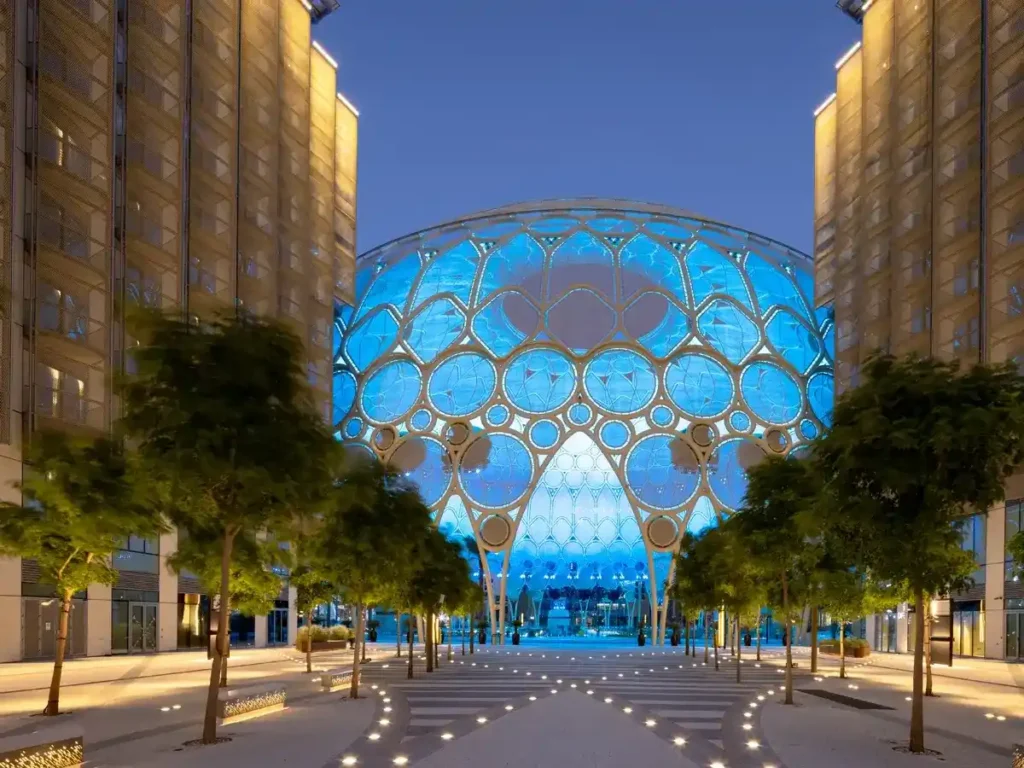
Expo City Dubai is the legacy transformation of the 4.38 square kilometre site that hosted Expo 2020 Dubai between October 2021 and March 2022. Rather than demolishing the venue after the exhibition closed, Dubai’s government repurposed roughly 80% of the built structures into a permanent city, keeping landmark buildings such as Al Wasl Plaza, Terra – The Sustainability Pavilion, and Alif – The Mobility Pavilion as public attractions while building new residential neighbourhoods around them.
The district now serves several roles at once: a tourist and events destination (it hosts GITEX GLOBAL, the region’s largest technology exhibition, at the Dubai Exhibition Centre), a growing residential community, and a business hub that is becoming home to DP World’s global headquarters and a campus for entrepreneurs and startups. In October 2024, Dubai’s Ruler, Sheikh Mohammed bin Rashid Al Maktoum, approved an updated AED 2.7 billion ($735 million) master plan that formalised how the residential and commercial expansion would unfold, aligning Expo City Dubai with the wider Dubai 2040 Urban Master Plan.
Expo City Dubai Location and Connectivity
Expo City Dubai sits in Dubai South, along Expo Road (E77) and close to Sheikh Mohammed Bin Zayed Road (E311), which makes it one of the more road-connected new communities in the emirate. It is roughly 20 minutes from Al Maktoum International Airport (DWC) – currently being expanded into what is planned to become the world’s largest airport – and it borders Dubai Investment Park, Jebel Ali and the wider Dubai South logistics and aviation district.
Public transport is a genuine strength here, which is unusual for a community this new. Expo City Dubai Station sits on Route 2020, the metro extension built specifically to serve the 2020 World Expo, connecting directly into the Red Line. From the station, central Dubai destinations such as Downtown Dubai and Business Bay are roughly 35–40 minutes away by metro. Internally, the community relies on shaded, pedestrian-friendly streets, cycling paths and shuttle buggies, reflecting the 15-minute city design that Expo City’s masterplanners have built around rather than around private cars.
The trade-off is distance from Dubai’s established core: residents commuting daily to Downtown Dubai, Dubai Marina or DIFC should factor in a real commute, even with direct metro access. Expo City Dubai suits people whose work, lifestyle or investment horizon is oriented toward Dubai South, Jebel Ali and the airport corridor rather than the traditional city centre.
Master Plan and the Five Districts
Expo City Dubai’s approved master plan organises the site into five districts, each with a distinct role. Understanding these is useful because most of the community’s current construction activity, and nearly all of the residential product on the market, is described in relation to them.
Expo Downtown is the highest-density district, running from the metro station out to Al Wasl Plaza and Terra. It is anchored by the Dubai Exhibition Centre and will include Terra Tower, planned as the tallest building in Expo City and combining high-end hospitality and office space, alongside the “floating” Terra Gardens and new residential buildings.
Expo Fields forms the main southern entry point into Expo City and is designed as a template for active, healthy living – it will include a school, sports fields, a 30,000-capacity open-air arena, clubhouses, retail and F&B alongside residential blocks and Alif Plaza.
Expo Hills, on the site’s northern edge with direct access from Expo Road, is a lower-density residential district built around a wadi-style landscape, offering more privacy while staying close to core amenities.
Expo Business extends the district’s existing commercial base into a campus-style environment aimed at startups, entrepreneurs and established companies – this is also where DP World’s relocated global headquarters sits.
Expo Valley, physically adjacent to the main masterplan site and linked by dedicated parks and micro-mobility paths, is a gated, low-density neighbourhood of villas, duets and townhouses set around a nature reserve, lake and wadi.
It’s worth noting that these five districts are distinct from the original Expo 2020 thematic zones – Opportunity, Mobility and Sustainability – which still exist as the geographic home of attractions like Alif and Terra but are not the same naming system used for the residential master plan. When a listing references “Expo Downtown” or “Expo Valley,” it’s referring to the new urban districts; when it references the “Sustainability District” or “Mobility District,” it’s referring to the original Expo 2020 layout, which mostly now overlaps with Expo Downtown and Expo Fields.
Altogether, the plan is designed to eventually house around 35,000 residents and 40,000 working professionals, built to LEED Gold, WELL Community Gold and BREEAM Excellent sustainability standards, with roughly 30,000 native trees planned across the landscaping.
Lifestyle and Attractions
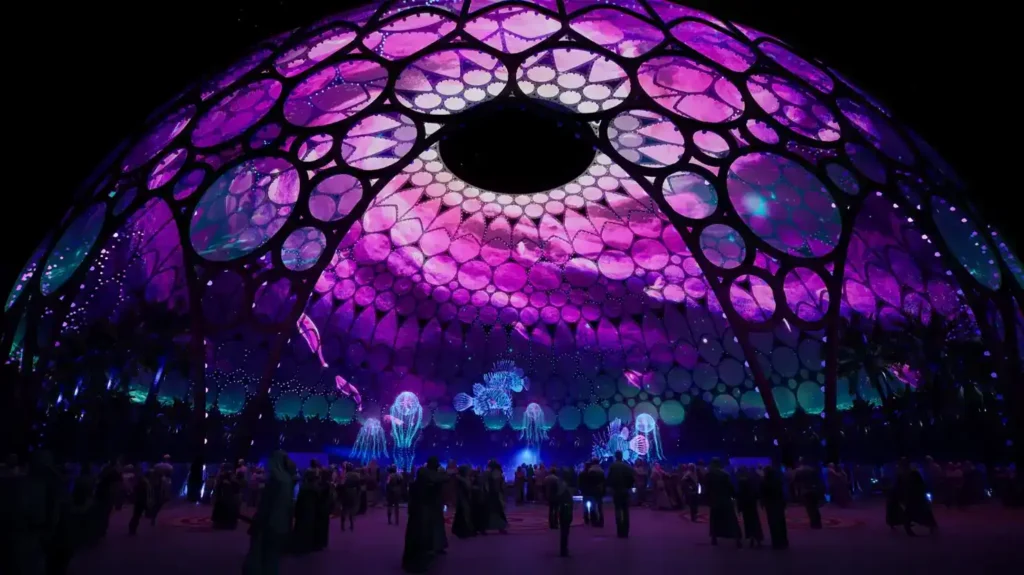
Life in Expo City Dubai today revolves as much around its public realm as its residences, since much of the community is still under construction. Al Wasl Plaza sits at the physical and symbolic heart of the site: a steel trellis dome holding the largest 360-degree interactive projection surface in the world, surrounded by gardens, pools and cafés, and used for events, festivals and evening light shows.
Terra – The Sustainability Pavilion and Alif – The Mobility Pavilion, the two flagship pavilions carried over from Expo 2020, remain the community’s must-see attractions, alongside the Expo 2020 Dubai Museum, the Vision Pavilion, and family-oriented spaces like Garden in the Sky (a rotating observation tower that lifts visitors 55 metres for panoramic views) and Latifa’s Playground for children. The public plazas, gardens and the Surreal water, fire and music feature are free to enter; the pavilions themselves require a separate Attractions Pass.
For residents, this translates into a community with an unusually high concentration of cultural programming, seasonal festivals (including the Dhai Dubai Light Festival, Ramadan evening markets, and winter events), dining options clustered around Al Wasl Plaza and Alif Plaza, and extensive parkland – around 45,000 square metres – laced with cycling and walking routes. The community is pedestrian-first by design, and its car-light internal layout, shaded streets and family-oriented public spaces make it genuinely walkable and pet- and child-friendly in the areas that are already built out, even as construction continues around the edges.
Residential Property Options in Expo City Dubai
Residential supply in Expo City Dubai is still in its early phases, concentrated in a small number of named projects rather than a mature, broad-based resale market. Buyers should expect an off-plan-heavy market with staggered handovers running from late 2026 through 2029.
Apartments. Mangrove Residences, developed within Expo City’s own portfolio, is one of the first apartment communities to reach handover, offering roughly 450 units across one- to three-bedroom apartments, four-bedroom lofts and three-bedroom townhouses, with views over Al Wasl Plaza and Jubilee Park. Sky Residences adds high-rise apartments (one to three bedrooms) with elevated views across the Expo City skyline. Emaar’s Terra Heights and Sidr Residences are newer entrants targeting the same buyer profile, with more premium positioning on the Sidr Residences product.
Townhouses and villas. Expo Valley is the community’s dedicated low-density neighbourhood, offering three- to five-bedroom villas, duets and townhouses set against a nature reserve, lake and wadi, with phased handovers starting in late 2026. Shamsa Townhouses, an Expo Dubai Group development within Expo Valley, offers three- and four-bedroom units built to high environmental standards with a “green link” connecting residents to nearby dining, entertainment and retail.
Commercial and office space. Expo Business and parts of Expo Downtown are being positioned as campus-style commercial zones aimed at startups and established companies, with additional office and hospitality space planned within Terra Tower.
Because most of this supply is still off-plan, buyers should treat unit specifications, delivery dates and even district boundaries as subject to change until a project reaches a firmer construction stage – a caveat that applies more strongly here than in established Dubai communities.
Property Prices and Rental Yields (2026)
Pricing across Expo City Dubai is still forming, and figures vary noticeably depending on project, unit size and how recently a launch went to market. As a general guide for 2026:
Off-plan one-bedroom apartments, such as those at Terra Heights, start from around AED 1.4 million, while premium apartments at Sidr Residences start from around AED 1.88 million. More broadly across the community’s apartment stock, prices typically fall in the AED 1.7–2 million range depending on size and building. Townhouses generally start from around AED 3.7–3.9 million, and villas – particularly the larger three- to five-bedroom units in Expo Valley – start from roughly AED 6.95 million and can run considerably higher for larger or better-positioned plots.
Rental yield estimates for Expo City Dubai typically sit in the 5–7% range, broadly in line with, or slightly below, the stronger yields seen in the wider Dubai South area (where gross yields of 6–8.5% have been reported). Because so much of Expo City’s residential stock is still off-plan, these yield figures are largely projected from comparable Dubai South and Route 2020 corridor properties rather than drawn from a deep base of confirmed Expo City transactions – a distinction worth keeping in mind rather than treating projected yields as guaranteed. Property values across the broader Dubai South and Expo City corridor have risen an estimated 10–20% since 2021, driven by metro connectivity, the airport expansion and increasing infrastructure investment.
Service charges on the community’s newer residential launches are estimated at around AED 14–18 per square foot annually, reflecting the cost of district cooling and the managed public realm that distinguishes Expo City from a typical suburban development.
Investment Potential and Outlook
Expo City Dubai’s investment case rests on three catalysts rather than on current, fully mature infrastructure: the ongoing expansion of Al Maktoum International Airport, DP World’s relocation of its global headquarters to the district, and Expo City’s role as the emirate’s primary large-format exhibition venue, most visibly through GITEX GLOBAL, which moves to the Dubai Exhibition Centre from December 2026. Each of these is expected to drive sustained demand for housing, hospitality and office space in the surrounding corridor over the coming years, particularly as airline routes and logistics operations at DWC scale up.
Against that, investors should weigh genuine early-stage risk. Most residential product remains off-plan, meaning buyers take on delivery and absorption risk that doesn’t exist when purchasing a completed, income-producing property in an established community. Social infrastructure – international schools and large-scale hospitals in particular – is still developing in the immediate vicinity, relying for now on the broader Dubai South area. Investors with a medium-to-long holding horizon, and those comfortable with a phased, multi-year build-out, are typically better positioned here than buyers looking for immediate rental income or a short resale window.
Expo City Dubai is a fully designated freehold zone, meaning foreign nationals and expatriates of any nationality can buy property here with 100% ownership rights, registered directly with the Dubai Land Department – the same ownership structure used across Dubai’s other freehold communities.
The Buying Process in Expo City Dubai
Buying in Expo City Dubai follows Dubai’s standard freehold purchase process, with a few practical considerations specific to a young, mostly off-plan community.
For off-plan purchases, buyers typically reserve a unit with a booking fee, sign a Sale and Purchase Agreement (SPA) with the developer, and follow a construction-linked payment plan – commonly structured around a 70/30 split (70% during construction, 30% on or after handover), sometimes with a post-handover payment window of a year or two, depending on the project. UAE mortgage lenders typically finance up to 80% loan-to-value for eligible residents on ready or near-complete units, though financing on very early-stage off-plan projects can be more limited.
Buyers should independently verify a project’s registration with the Dubai Land Department (DLD) and RERA’s Oqood system before transferring any funds, confirm the developer’s track record and current construction stage, and review the payment plan and service charge schedule in detail – figures that can differ meaningfully between buildings even within the same district.
Property ownership in Expo City Dubai can also support UAE residency. Under current rules, a property purchase can qualify a sole owner for a two-year investor visa, while a Golden Visa (offering longer-term residency) generally requires a property investment of at least AED 2 million. Dubai levies no annual property tax on residents, though a one-time Dubai Land Department transfer fee (typically 4% of the purchase price) and standard registration costs apply at the point of sale, as in the rest of the emirate.
Schools, Healthcare and Family Amenities
This is the area where prospective residents should set realistic expectations. Expo City Dubai’s master plan includes a school and community-scale amenities within Expo Fields, and family-friendly design – parks, playgrounds, wide pedestrian streets – is already visible across the built portions of the site. However, as of 2026, large-scale international schools and hospitals directly within Expo City itself are still in early planning or construction stages.
In practice, most residents currently rely on the broader Dubai South area for schooling, healthcare and larger retail needs, with additional options available a short drive away in Jebel Ali and Dubai Investment Park. Families considering Expo City Dubai today should treat it as a community whose social infrastructure will mature over the next several years, alongside its residential population, rather than one that already offers the full amenity base of an established Dubai suburb.
Who Expo City Dubai Suits Best
Expo City Dubai tends to appeal most to three buyer profiles. Long-horizon investors drawn to the airport expansion, DP World’s relocation and the district’s growing events calendar can find attractive entry pricing relative to Dubai’s more established freehold communities, provided they’re comfortable with off-plan risk and a multi-year build-out. Remote and hybrid professionals, or those working in aviation, logistics or the Dubai South free zone, benefit from proximity to DWC and a direct metro link without needing a daily commute into central Dubai. Families prioritising green space, walkability and a quieter, car-light environment may find the community’s design appealing today, so long as they’re prepared to source schools and larger healthcare needs from the surrounding Dubai South area in the near term.
Buyers who need mature retail, dense dining options, or a fully built-out neighbourhood on move-in day are likely better served by an established community for now, and may want to revisit Expo City Dubai as later phases complete.
Expo City Dubai vs. Nearby Communities
Compared with Dubai South’s broader residential districts, Expo City Dubai generally commands a pricing premium, reflecting its landmark public realm, sustainability credentials and cultural programming – features that plain residential Dubai South communities don’t offer. Compared with more established metro-connected communities such as Dubai Marina or Downtown Dubai, Expo City Dubai offers materially lower entry prices and a quieter, greener setting, but with a longer wait for full social infrastructure and a longer commute into the traditional city centre. For buyers weighing these trade-offs, the right choice tends to come down to time horizon: shorter-term liquidity and immediate amenities favour established areas, while longer-term upside and lower entry pricing favour Expo City Dubai.
FAQs
Is Expo City Dubai a good place to invest in 2026?
It can be, for investors with a medium-to-long holding period. Pricing is currently lower than in established freehold areas, and catalysts like the Al Maktoum Airport expansion and DP World’s headquarters relocation support long-term demand, but most stock is still off-plan and social infrastructure is still developing.
Is Expo City Dubai freehold?
Yes. It is a fully designated freehold zone, allowing foreign nationals and expatriates of any nationality to purchase property with 100% ownership, registered with the Dubai Land Department.
How do you get to Expo City Dubai by metro?
Route 2020, an extension of the Dubai Metro Red Line, runs directly to Expo City Dubai Station. The journey from central areas like Downtown Dubai typically takes around 35–40 minutes.
How far is Expo City Dubai from Dubai Marina and Downtown Dubai?
By road or metro, both are roughly 35–45 minutes away, depending on traffic and the specific starting point.
What residential projects are currently available in Expo City Dubai?
Active or recently launched projects include Mangrove Residences and Sky Residences (apartments), Terra Heights and Sidr Residences (apartments), and Expo Valley and Shamsa Townhouses (villas and townhouses).
What are current property prices in Expo City Dubai?
Off-plan one-bedroom apartments generally start from around AED 1.4–1.9 million, townhouses from around AED 3.7–3.9 million, and villas from roughly AED 6.95 million upward, though prices vary by project and unit specification.
What rental yields can investors expect in Expo City Dubai?
Estimates typically range from 5% to 7%, based on comparable Dubai South and Route 2020 corridor data, since Expo City itself still has limited confirmed rental transaction history.
Are there international schools in Expo City Dubai?
A school is planned within the Expo Fields district, but as of 2026 large-scale international schools are not yet operating directly within Expo City; most residents currently use schools in the wider Dubai South area.
Is Expo City Dubai family-friendly?
Yes, in design terms – it offers extensive parkland, pedestrian-first streets, playgrounds and low-traffic layouts. Families should note that broader social infrastructure like schools and hospitals is still expanding in the surrounding area.
What is there to do in Expo City Dubai?
Highlights include Al Wasl Plaza, Terra – The Sustainability Pavilion, Alif – The Mobility Pavilion, the Expo 2020 Dubai Museum, Garden in the Sky, extensive parks, and regular festivals and events. Public plazas and gardens are free to enter; the pavilions require a paid Attractions Pass.
Does GITEX take place in Expo City Dubai?
Yes. GITEX GLOBAL, the region’s largest technology and AI exhibition, relocates to the Dubai Exhibition Centre within Expo City Dubai starting with its December 2026 edition.
What is the difference between Expo City Dubai and Dubai South?
Expo City Dubai is a distinct, landmark mixed-use district within the wider Dubai South master development. Dubai South is the larger surrounding area, encompassing residential, logistics, aviation and business districts, of which Expo City Dubai is one high-profile part.
Can I get a UAE Golden Visa by buying property in Expo City Dubai?
Property investments of at least AED 2 million can qualify for a UAE Golden Visa, and smaller investments can qualify for a shorter-term investor visa, under the same rules that apply across Dubai’s freehold communities.
Is Expo City Dubai a good long-term rental investment or better suited to end users?
Both profiles are represented in current demand, but given the off-plan-heavy supply and developing infrastructure, it currently suits long-term investors and lifestyle-driven end users more than buyers seeking immediate rental income or short-term resale.
When will Expo City Dubai be fully completed?
There is no single completion date; the master plan is being delivered in phases, with major residential handovers expected between late 2026 and 2029, and further districts developing over the following years in line with the Dubai 2040 Urban Master Plan.
A Practical Next Step
Expo City Dubai in 2026 is a community defined by its trajectory rather than its finished state: strong transport links and a distinctive public realm already exist, while schools, hospitals and a deeper resale market are still being built out around them. Before committing to a specific project, it’s worth verifying current asking and transaction prices, service charges, developer construction progress, and realistic commute times against your own priorities – figures that can shift meaningfully between buildings and phases even within the same district. Our team at Dubai Property Plus can walk you through current listings, payment plans and comparable data across Expo City Dubai and the wider Dubai South corridor to help you make that decision with confidence.

Leave a Reply