
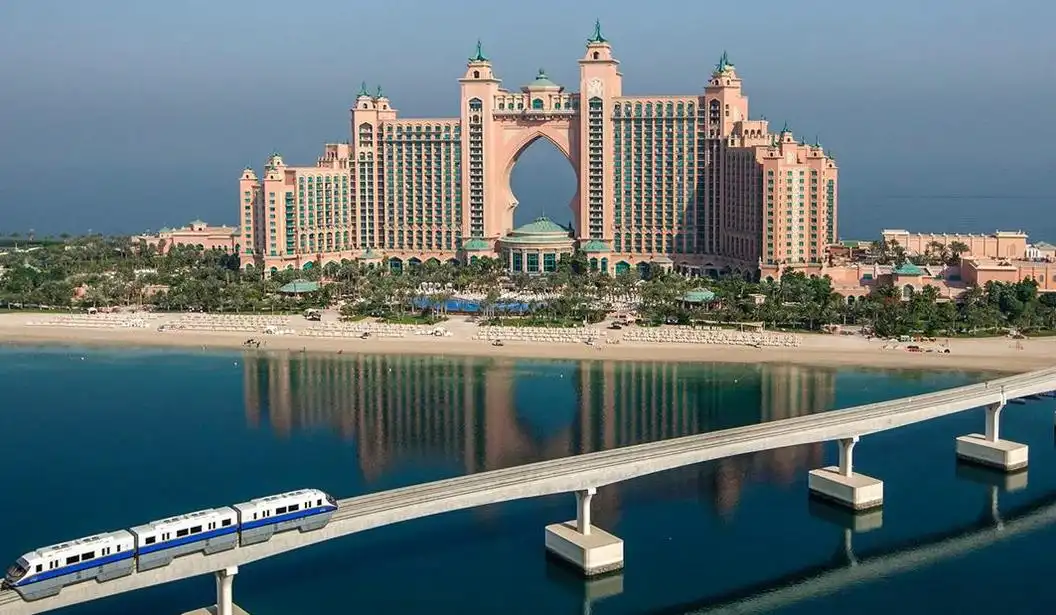

The Palm Monorail is the elevated rail line that runs along the Trunk of Palm Jumeirah, linking the mainland entrance at Palm Gateway to Atlantis The Palm. It is not part of the Dubai Metro network. It is a standalone, Nakheel-owned system, operated by Serco, that has served as the main form of public transport on the island since 2009. For anyone researching Palm Jumeirah as a place to live, invest, or visit, understanding the monorail matters because it shapes how walkable, connected, and rentable different parts of the island actually are.
As of writing, the Palm Monorail has been suspended since December 2025 for essential station maintenance, with Nakheel and Serco yet to confirm a reopening date. This guide covers the full route and station network, what the current closure means for residents and visitors, how the monorail connects to the wider Dubai transport system, and – because this matters just as much to anyone searching “Palm Monorail” with property in mind — what it all means for buying, renting, and investing on Palm Jumeirah in 2026.
What Is the Palm Monorail and Why It Exists
Palm Jumeirah was built without road access to every corner of its 17 fronds when it first opened, and Nakheel needed a way to move residents, hotel guests, and tourists from the mainland to Atlantis without adding thousands of cars to a single access road. The answer was a 5.45-kilometre elevated monorail, engineered using Hitachi’s straddle-type monorail technology, with electro-mechanical works delivered by ETA-Dubai in partnership with Hitachi Japan.
The line opened on 30 April 2009 as the Palm Jumeirah Monorail, making it the first monorail system in the Middle East. It runs roughly 10 metres above ground level along the Trunk, giving passengers uninterrupted views of the Arabian Gulf, the Dubai Marina skyline, and the villas lining the fronds below. A full end-to-end journey takes about nine minutes, with roughly three minutes between each station.
The trains themselves are driverless, monitored by onboard attendants for emergencies, and each carriage seats 70 people with standing room for 232 more, giving a single train a capacity of 302 passengers. The system was designed with a theoretical capacity of 40,000 passengers a day, though real-world ridership has historically run far lower than that figure, closer to a few thousand daily riders in recent years.
Palm Monorail Stations: The Complete Route
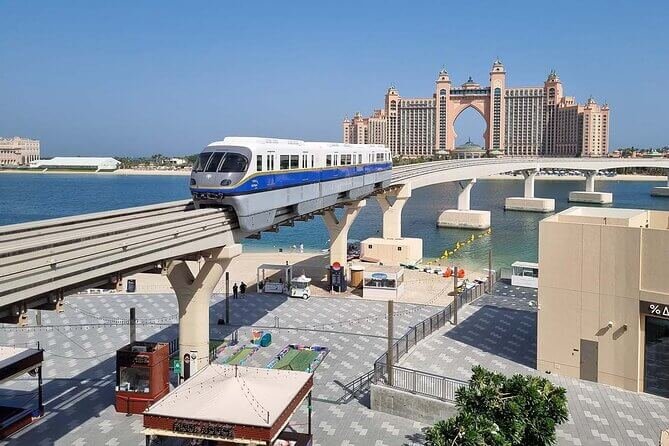
The Palm Monorail currently operates four stations along its route, down from an original plan for more stops as the island’s masterplan evolved. Understanding what sits at each station is the fastest way to understand the geography of Palm Jumeirah itself, since the monorail’s stops effectively mark the island’s key activity centres.
Palm Gateway Station
Palm Gateway is the first station and the monorail’s connection point to the mainland. It sits at the base of the Trunk, near Dubai Media City, and functions as the practical starting point for anyone arriving without a car. The station has more than 1,600 parking spaces, making it a common choice for day-trippers who drive to the Palm, park at Gateway, and continue by monorail. Gateway Station also connects, via an out-of-station interchange, to the Dubai Tram at the Palm Jumeirah tram stop, which in turn links onward to the Dubai Metro Red Line at Sobha Realty (formerly DAMAC Properties) station in Dubai Marina.
Al Ittihad Park Station
The second stop serves Al Ittihad Park, a green space that has become one of the more popular outdoor amenities on the island. The park has a 3.2-kilometre running track, open-air workout stations, and more than 100 species of trees and plants native to the UAE, making it a genuine fitness and leisure draw rather than a purely decorative green patch. This station was originally built to serve the cancelled Trump International Hotel and Tower project and opened to the public on 3 July 2017 under a different name before being repurposed. From here, residents and visitors can also reach the Golden Mile Galleria retail strip and Palm West Beach on foot.
Palm Jumeirah Mall Station (formerly Nakheel Mall Station)
Opened on 28 November 2019 alongside the mall itself, this station gives direct access to Palm Jumeirah Mall, the island’s main retail and leisure hub. The mall houses a cinema, a wide range of international retail brands, dining options covering most global cuisines, and a supermarket for everyday shopping. The station also connects pedestrians to The Palm Tower, home to The View at The Palm observation deck, the St. Regis Dubai The Palm, and Club Vista Mare’s restaurant strip. For residents living in Trunk-based apartment towers, this station is typically the most used stop on the line.
Atlantis Aquaventure Station
The final station sits at the entrance to Atlantis The Palm and its Aquaventure Waterpark, one of the most visited attractions in the Middle East. This stop sees the heaviest tourist footfall of the four, particularly during UAE school holidays and the October-to-April peak season, when day-trippers combine a waterpark visit with lunch or a beach day at the resort.
A fifth stop, The Pointe station, has been closed since July 2023 as part of a redevelopment project and has not reopened at the time of writing.
Current Status: Is the Palm Monorail Running in 2026?
No. The Palm Monorail has been suspended since 5 December 2025, with Nakheel and Serco citing essential station maintenance. Official channels, including the operator’s social media accounts, described the closure timeline as unconfirmed as of early April 2026, and no public reopening date had been announced at the time this guide was last checked. Anyone planning a visit to Palm Jumeirah or relying on the monorail for a daily commute should verify current status directly with Palm Monorail’s official channels before travelling, since a maintenance closure of this length is unusual for the line’s operating history.
During the suspension, alternative routes to the island include the Dubai Tram, which connects to several bus routes serving Palm Gateway, along with taxis and ride-hailing services for the final stretch onto the Trunk. Residents who own cars have not been meaningfully affected, since road access along the Trunk remains open throughout.
How the Palm Monorail Fits Into Dubai’s Wider Transport Network
One of the most searched questions about this system is whether it connects directly to the Dubai Metro. It does not, at least not yet. The Palm Monorail is a self-contained line with no physical track connection to the Metro’s Red Line or Green Line. The closest Metro station to Palm Jumeirah is Sobha Realty station on the Red Line, located in Dubai Marina.
The practical route from the Metro to the Palm runs through the Dubai Tram: passengers take the Red Line to Sobha Realty, transfer to the Dubai Tram, ride it to the Palm Jumeirah tram stop near Palm Gateway, then either walk into the monorail station (when operating) or continue by taxi. There has long been a proposed extension linking the monorail to the Red Line directly, with an additional budget of roughly USD 190 million earmarked for a 2-kilometre connector, but this extension has not been built as of 2026.
For residents who drive, Palm Jumeirah connects to the rest of Dubai via Al Sufouh Road and Sheikh Zayed Road, putting Dubai Marina roughly 10 minutes away, Downtown Dubai and Business Bay around 20 minutes away, and Dubai International Airport about 30 minutes away under normal traffic conditions. Traffic on the single access road onto the Trunk can build up during weekend evenings and major events at Atlantis, which is one reason the monorail — when running — remains a useful way to avoid congestion for short trips within the island itself.
Palm Jumeirah: The Island the Monorail Serves
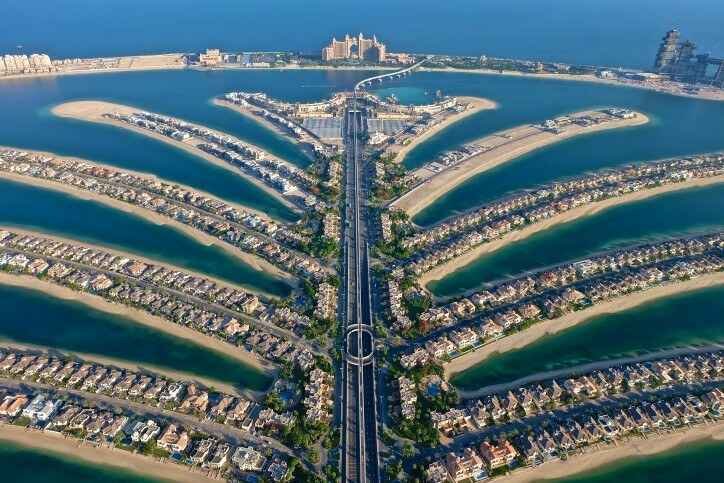
Understanding the monorail is really a way of understanding Palm Jumeirah’s layout, since the island is structured around three distinct zones that the monorail was built to connect.
The Trunk is the spine of the palm shape and the most urbanised part of the island. It houses the bulk of Palm Jumeirah’s apartment towers, the Palm Jumeirah Mall, Golden Mile Galleria, Al Ittihad Park, and Palm West Beach. Most day-to-day retail, dining, and community life on the island happens here, and it is the section the monorail runs directly through.
The 16 Fronds branch off the Trunk on either side and are given over almost entirely to villas. These are gated, low-density residential streets with direct private beach access, water channels between each frond suitable for paddleboarding, and considerably more privacy than anywhere else on the island. Villa buyers on the Palm are typically drawn specifically to frond living rather than the Trunk.
The Outer Crescent forms the breakwater around the outside of the fronds and hosts a mix of hotels and select ultra-luxury developments, including branded residences positioned for direct sea views and skyline vistas back toward Dubai Marina and Burj Al Arab.
Palm Jumeirah is a fully freehold area, meaning foreign nationals can own property here with complete ownership rights, a status that has made it one of the most internationally traded addresses in the emirate.
Lifestyle on Palm Jumeirah: What Living Near the Monorail Route Actually Looks Like
Life on the Trunk, within walking distance of a monorail station, tends to feel closer to resort living layered on top of a genuine residential community. Palm West Beach gives Trunk residents a public beachfront promenade lined with cafés and restaurants, distinct from the private beaches attached to frond villas and hotels. Al Ittihad Park functions as the community’s green lung, drawing a consistent crowd of runners and families in the cooler morning and evening hours. Palm Jumeirah Mall covers most everyday needs, from groceries to entertainment, without requiring a trip off the island.
Families considering the Palm should note that schooling options are located off-island rather than on it; most Palm Jumeirah households send children to schools in nearby Dubai Marina, Jumeirah Beach Residence, or Al Sufouh, with a daily school run typically factored into the commute. Healthcare follows a similar pattern, with major hospitals and clinics concentrated in Jumeirah, Dubai Marina, and Al Sufouh rather than on the Palm itself, though some hotels and residential towers offer on-site clinics for routine care.
Pet owners generally find frond villas better suited to their needs than Trunk apartments, given private garden space, though several apartment buildings and Al Ittihad Park do accommodate leashed pets. Walkability is strong within the Trunk itself, particularly between the Mall, Golden Mile Galleria, and Al Ittihad Park, but the island’s overall length means that getting from Gateway to Atlantis on foot is not realistic, which is precisely the gap the monorail is designed to close.
Palm Jumeirah Property Market: Prices, Property Types, and Investment Potential in 2026
Palm Jumeirah’s real estate market divides cleanly along the same geography the monorail traces: Trunk apartments offer liquidity and rental income, while frond villas offer scarcity-driven capital appreciation.
Apartments on the Trunk
Trunk apartments range from studios to four-bedroom units, with well-known buildings including Azure Residences, Five Palm Jumeirah, Shoreline Apartments, and the newer Palm Beach Towers development by Nakheel, expected to hand over in phases through late 2026. Entry-level one-bedroom apartments in older buildings can start from around AED 1 million, while newer or branded developments comfortably exceed AED 2 million to AED 3 million for comparable layouts. Average price per square foot for apartments on the Palm generally sits in the AED 3,500 to AED 4,090 range, among the highest in Dubai, reflecting the location’s scarcity and international brand recognition.
Gross rental yields on Trunk apartments typically run between 5% and 7.3%, depending on the building, unit size, and whether it is let long term or managed as a short-term holiday rental. Studios often post the strongest percentage yields due to their lower entry price relative to nightly or monthly rental rates, while larger units generate higher absolute rental income. Short-term and holiday-let apartments can achieve gross yields of 7% to 9% during the peak October-to-April season, though this requires active management and carries higher vacancy risk outside peak months.
Villas on the Fronds
Villa pricing on Palm Jumeirah operates in an entirely different bracket. Garden Homes, the more compact villa category, generally range from roughly AED 18.5 million to AED 45 million depending on the frond and renovation status. Larger Signature Villas with five to seven bedrooms commonly trade between AED 60 million and AED 120 million, and fully rebuilt custom mansions on prime fronds can exceed AED 150 million to AED 200 million. The average villa price across the island sits at approximately AED 44.6 million, with price per square foot averaging close to AED 4,800.
Villa rental yields are lower in percentage terms than apartments, typically 3% to 6% gross, but far higher in absolute income given the rent rolls involved; four-bedroom villas have posted some of the strongest reported returns on the island when combining rental income with capital growth. Villas purchased during the 2020 market low have, in several documented cases, appreciated by 200% or more by early 2026, driven by a combination of pandemic-era demand recovery, a fixed and non-expanding supply of frond plots, and continued international capital inflow.
What Drives Investment Demand
Three structural factors underpin Palm Jumeirah’s investment case. First, supply is effectively capped: there is no room to build additional fronds, and any new stock comes from redevelopment of existing plots rather than fresh land release, which supports long-term pricing. Second, any property purchase of AED 2 million or more qualifies the buyer for the UAE’s 10-year Golden Visa, a benefit that has meaningfully broadened the buyer pool beyond purely rental-yield-focused investors. Third, the relaunch of Palm Jebel Ali as a second, larger palm-shaped island has not diluted demand for Palm Jumeirah; if anything, it has reinforced the original Palm’s positioning as Dubai’s “heritage” luxury address, given its closer proximity to Dubai Marina, Burj Al Arab, and Downtown Dubai.
Buyers should also budget for ongoing costs beyond the purchase price. Villa service charges typically range from AED 3 to AED 6 per square foot of plot area annually, while branded apartment buildings can charge AED 35 to AED 45 per square foot, reflecting the higher-touch concierge and amenity services those buildings provide.
Off-Plan and New Launches
Several new residential projects are in active construction or sales phases on the Palm as of 2026, including Nakheel’s Palm Beach Towers, The Palm Crown (one of the last true beachfront villa and plot releases in Nakheel’s original masterplan), and branded developments such as Armani Beach Residences and Six Senses The Palm. Off-plan buyers on the Palm should weigh the appeal of a brand-new, fully warrantied unit against the scarcity value of established Trunk and frond addresses, since resale liquidity on the Palm tends to favour recognised, established buildings over newer stock still working through its handover cycle.
Buying Process on Palm Jumeirah: What Foreign Buyers Need to Know
Because Palm Jumeirah is a freehold zone, the purchase process follows Dubai’s standard freehold transaction path rather than any special island-specific rules. A buyer identifies a property, agrees terms, and signs a Memorandum of Understanding (commonly called Form F) along with a deposit, typically 10% of the purchase price for ready properties. The transaction is then registered with the Dubai Land Department, and for mortgaged purchases, a No Objection Certificate from the developer is required before final transfer. Off-plan purchases follow a payment plan set by the developer and registered through the Dubai Land Department’s Oqood system rather than a single lump-sum transfer.
Foreign buyers face no restrictions on ownership, resale, leasing, or inheritance planning within freehold areas like Palm Jumeirah, and remote transactions using power of attorney and digital verification are accepted by UAE banks and the Land Department, making the process accessible to international buyers who cannot travel to Dubai in person.
Frequently Asked Questions
Is the Palm Monorail still running in 2026?
No. The Palm Monorail has been suspended since 5 December 2025 for maintenance work, and no confirmed reopening date has been announced. Check the operator’s official channels before planning a trip.
Does the Palm Monorail connect to the Dubai Metro?
Not directly. There is no physical track link between the monorail and the Metro. Passengers transfer via the Dubai Tram, which connects the Palm Jumeirah tram stop to the Red Line at Sobha Realty station in Dubai Marina. A direct monorail-to-Metro extension has been proposed but not built.
How many stations does the Palm Monorail have?
Four stations are currently in operation: Palm Gateway, Al Ittihad Park, Palm Jumeirah Mall, and Atlantis Aquaventure. A fifth station, The Pointe, has been closed since 2023 for redevelopment.
How long does the Palm Monorail journey take?
The full end-to-end trip from Palm Gateway to Atlantis Aquaventure takes about nine minutes, with roughly three minutes between consecutive stations, when the line is operating normally.
How much does a Palm Monorail ticket cost?
Under normal operation, single-journey tickets start from around AED 20 with return tickets from around AED 30 to AED 35, though promotional and online pricing has varied. Tickets are purchased at station kiosks or online through the official website.
Can I park at a Palm Monorail station?
Yes. Palm Gateway station has more than 1,600 parking spaces, and validated monorail tickets typically include a few hours of free parking before hourly charges apply.
What can I do at each Palm Monorail station?
Palm Gateway connects to the Dubai Tram and mainland parking. Al Ittihad Park gives access to the park’s running track and Golden Mile Galleria. Palm Jumeirah Mall connects to the mall, The Palm Tower, and The View at The Palm. Atlantis Aquaventure sits at the entrance to Atlantis The Palm and its waterpark.
Is Palm Jumeirah a good place to invest in property in 2026?
Palm Jumeirah remains one of Dubai’s strongest capital-appreciation markets, driven by fixed supply and consistent international demand, though rental yields are moderate compared with some other Dubai communities. It suits investors with a medium- to long-term horizon who prioritise capital growth and prestige alongside rental income, rather than those chasing the highest short-term yield percentages.
What is the rental yield on Palm Jumeirah apartments?
Gross rental yields on apartments generally range from 5% to 7.3%, with short-term holiday lets reaching 7% to 9% during peak season. Net yields after service charges and management fees typically run 1 to 2 percentage points lower.
Are villas or apartments better for rental income on Palm Jumeirah?
Apartments generally deliver higher percentage yields due to lower entry prices, while villas deliver higher absolute rental income due to their scale, even at lower percentage yields. The right choice depends on whether an investor is optimising for yield efficiency or total cash return.
Does buying property on Palm Jumeirah qualify for a UAE Golden Visa?
Yes. Any property purchase of AED 2 million or more on Palm Jumeirah qualifies the buyer for the UAE’s 10-year Golden Visa, extendable to immediate family members.
Are there schools and hospitals on Palm Jumeirah itself?
No major schools or hospitals are located directly on the island. Most residents rely on schools and healthcare facilities in nearby Dubai Marina, Jumeirah Beach Residence, and Al Sufouh, typically a short drive away.
Can foreigners buy property on Palm Jumeirah?
Yes. Palm Jumeirah is a designated freehold area, allowing foreign nationals to own property outright with full ownership rights, including the right to resell, lease, or pass the property on through inheritance.
What is the difference between the Trunk, the Fronds, and the Outer Crescent?
The Trunk is the main spine of the island, home to apartments, the mall, and everyday amenities. The Fronds are the 16 branches given over mainly to gated villa communities with private beach access. The Outer Crescent is the breakwater ring hosting hotels and select ultra-luxury residences.
Is Palm Jumeirah walkable? Within the Trunk, yes — the mall, Al Ittihad Park, and Golden Mile Galleria are all within comfortable walking distance of each other. The island’s overall length makes end-to-end walking impractical, which is the gap the monorail (when operating) and private transport fill.

Leave a Reply