
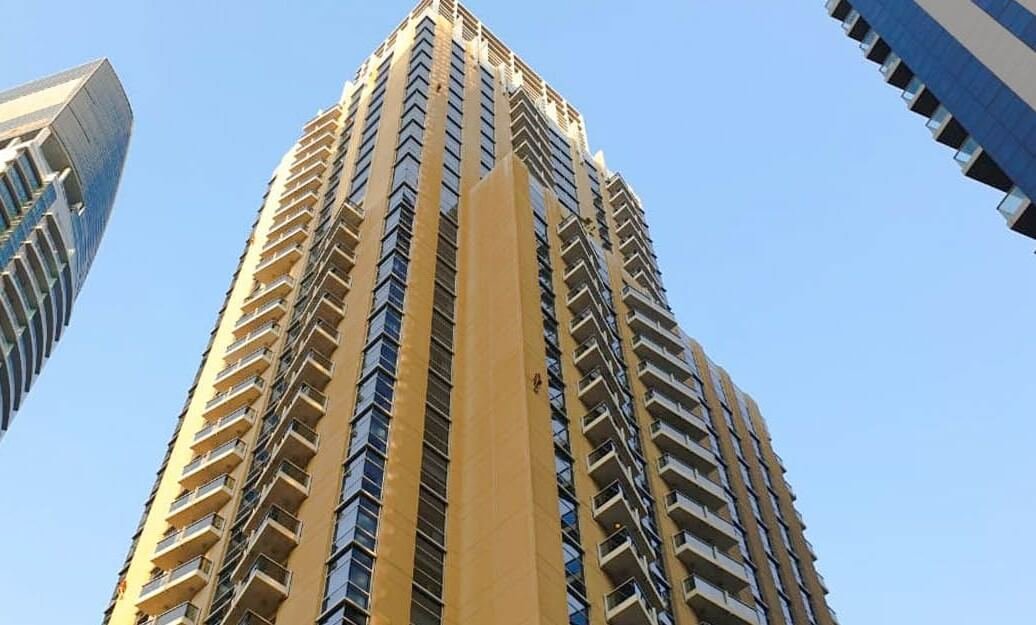

Dubai Marina is home to more than 200 residential towers built around a 3.5-kilometre man-made canal, which is why the phrase “Dubai Marina Towers” gets used two ways. Most people searching for it mean the whole cluster of high-rises that make up the Marina skyline – the Princess Towers, Cayan Towers, Marina Gates and dozens of others. A smaller group means one specific development: Marina Towers, the original six-building complex – Al Mass, Fairooz, Murjan, Mesk, Yass and Anbar – built by Emaar Properties at the northern gateway to the community. This guide covers both. It explains what Dubai Marina’s towers offer as a whole, profiles the landmark buildings by name, and breaks down prices, rental yields, connectivity and lifestyle for anyone buying, renting or investing in 2026.
What Is Dubai Marina, and What Are Its Towers?
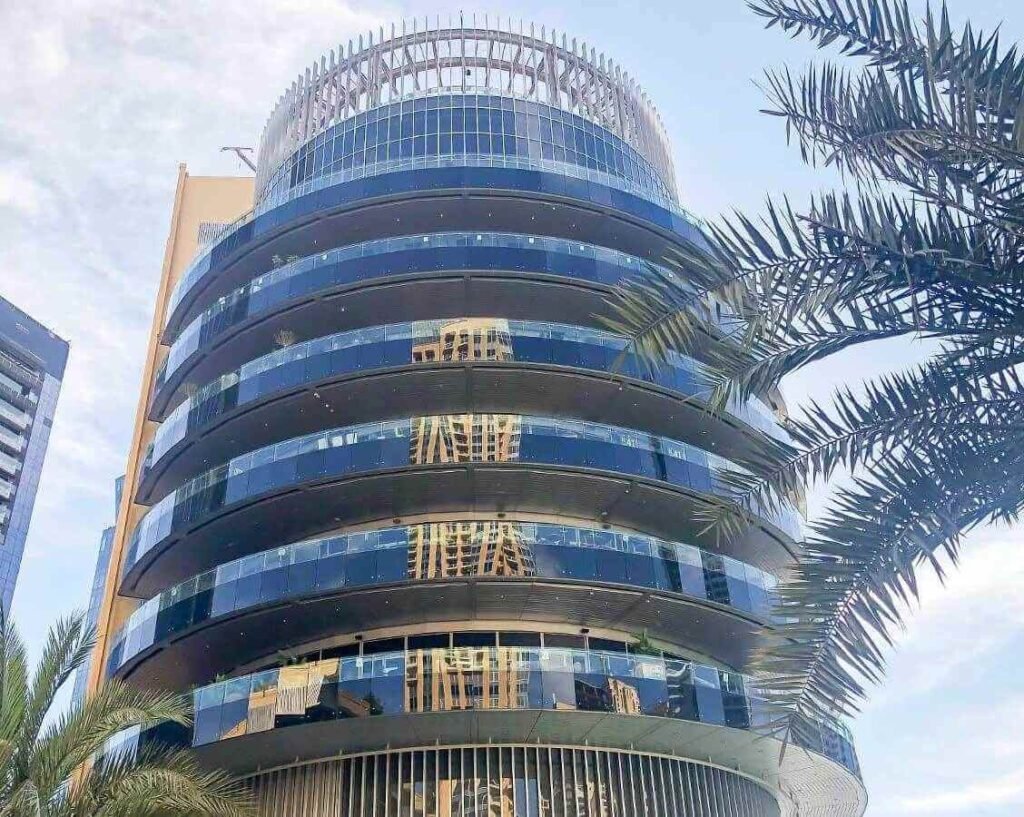
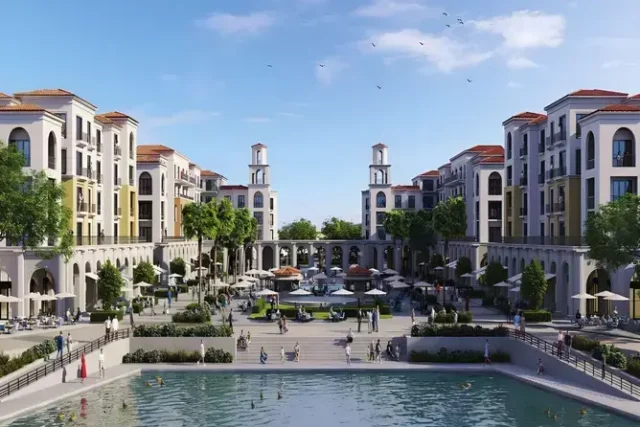
Dubai Marina, sometimes called Marsa Dubai, is a purpose-built waterfront district carved out of the Arabian Gulf coastline by Emaar Properties, with the original masterplan designed by HOK Canada. The concept was inspired by the Concord Pacific development along False Creek in Vancouver: bring the sea inland, line it with towers, and build a promenade around it. The result is a 3 to 3.5-kilometre canal flanked by residential and commercial skyscrapers, with almost 8 kilometres of landscaped public walkway threading through the community.
The district sits at Interchange 5 on Sheikh Zayed Road, between Jumeirah Beach Residence (JBR) to the west and Jumeirah Lake Towers (JLT) to the east. As of the most recent population count, Dubai Marina had roughly 70,000 residents, with capacity for well over 120,000 once fully occupied. A cluster of its tallest buildings – many rising between 250 and 300 metres, with a handful exceeding 350 metres – earned the district the nickname “the tallest block in the world.”
Marina Towers itself, the six-building Emaar complex that gave the area its early identity, was the first phase of the development. It sold out shortly after launching in 2002, and its buildings are still named in pairs – three after precious stones (Al Mass, Fairooz, Murjan) and three after Arabic fragrances (Mesk, Yass, Anbar) – a naming convention that still shows up on floor plans and title deeds today.
Location, Boundaries and Connectivity
Dubai Marina’s location on Sheikh Zayed Road is its biggest structural advantage. The community borders Al Sufouh Road and sits close to Dubai Internet City, Dubai Media City and the American University in Dubai, which keeps a steady base of professional tenants close to their offices. Dubai International Airport (DXB) is roughly a 25 to 30-minute drive in typical traffic, while Al Maktoum International Airport in Dubai South is around 35 minutes away.
Public transport is one of the community’s stronger selling points. Two Dubai Metro stations serve the area on the Red Line: Sobha Realty Metro Station (formerly known as Damac Station and, before that, Dubai Marina Station) and DMCC Metro Station, both elevated on viaducts alongside Sheikh Zayed Road with pedestrian bridges connecting to towers on either side. The Dubai Tram runs 11 stations between JBR and Al Sufouh, looping through the heart of the Marina itself – the Marina Towers Tram Station sits close to Marina Pinnacle and MAG 218 Tower, making it one of the most useful stops for residents without a car.
That said, internal circulation has a well-known trade-off. Because the tram crosses several internal roads at grade, residents often mention frequent traffic-light stops when driving in and out of the community, particularly during peak hours. It is a fair point to weigh against the walkability the tram otherwise provides.
Marina Towers (Emaar 6 Towers): The Original Landmark Complex
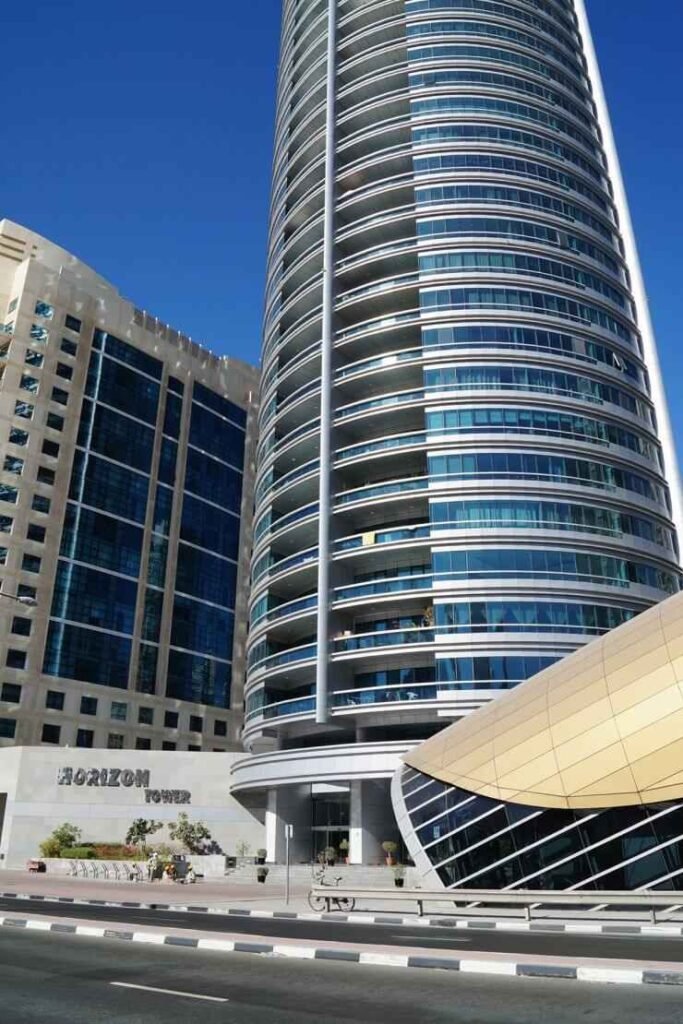
If you searched specifically for “Marina Towers” rather than the district as a whole, this is the development in question. Emaar’s six-tower complex sits at the Marina’s northern entrance, giving residents some of the most direct access to the promenade and open water in the community.
The individual towers vary in height and unit mix:
| Tower | Approx. Floors | Naming Theme |
|---|---|---|
| Murjan | 40 | Precious stone |
| Mesk | 40 | Arabic fragrance |
| Al Mass | 31 | Precious stone |
| Yass | 27 | Arabic fragrance |
| Fairooz | 23 | Precious stone |
| Anbar | 19 | Arabic fragrance |
Together the six buildings comprise just over 1,000 apartments across roughly 260,000 square metres of residential floor area, plus a small number of villas. Apartments range from around 1,025 to just under 7,000 square feet, spanning one, two and three-bedroom layouts through to larger penthouses with wraparound balconies and, in some units, private Jacuzzis. In-house amenities include ground-floor retail, cafés, a supermarket, a spa, salons, children’s play areas and dedicated marina berths for residents who own boats – a detail that sets Marina Towers apart from many newer Marina buildings.
Because these towers were among the first delivered, unit finishes and building services vary more between individual apartments than in newer developments, so a building inspection and service-charge review are worth doing before committing to a purchase here.
Other Iconic Towers in Dubai Marina
Beyond the original six, Dubai Marina’s skyline includes some of Dubai’s most recognisable residential addresses. A short list of the towers that come up most often in buyer and tenant searches:
- Princess Tower – a 101-storey building that held the title of the world’s tallest residential tower from 2012 to 2015, with roughly 763 units ranging from one-bedroom apartments to five-bedroom penthouses, plus a 97th-floor observation deck.
- Marina 101 – at 425 metres, currently the tallest building in Dubai Marina, combining residential floors with a hotel component.
- Cayan Tower – recognisable for its 90-degree structural twist, developed with a distinctive silhouette that has become one of the most photographed buildings on the Marina skyline.
- Marina Gate I, II & III – a Select Group development combining two residential towers and a serviced-apartment tower connected by a landscaped podium, popular with both long-term tenants and short-stay operators.
- 23 Marina – a 90-floor luxury tower known for Marriott-managed finishes and strong short-term rental demand.
- Bay Central (East, Central, West) – three connected towers offering a more accessible entry point, with roughly 747 units across studios to three-bedroom apartments.
- Damac Heights, Ocean Heights, Sulafa Tower, Ciel Dubai Marina and Park Island (Blakely, Sanibel, Fairfield and Bonaire towers) round out the list of buildings frequently compared by buyers and renters.
Each of these towers has a distinct profile in terms of build quality, service charges and rental performance, so treat “Dubai Marina” less as a single market and more as a collection of micro-markets stacked vertically along the same canal.
Property Types in Dubai Marina
The overwhelming majority of stock in Dubai Marina is apartments – studios, one, two and three-bedroom units, and penthouses in the taller towers. Villas exist but are limited, generally ranging from two to six bedrooms across roughly 2,450 to 9,600 square feet, with features like maid’s rooms, powder rooms and rooftop terraces. Ground-floor retail and F&B units are common across almost every tower podium, and a small number of buildings include dedicated office floors aimed at businesses that want a Marina address without a Business Bay or DIFC price tag.
For most buyers and tenants, the practical choice comes down to three variables: marina-facing versus city-facing (a view premium of roughly 10 to 20 percent is typical for direct waterfront units), tower age (older Marina 1 and Marina 2-era buildings versus newer, better-specified towers), and proximity to the tram line, which tends to correlate with both rental demand and resale liquidity.
Lifestyle and Amenities
Life in Dubai Marina revolves around the water. Dubai Marina Walk is a roughly 7-kilometre promenade lined with cafés, restaurants and boutique retail – one of the most walkable stretches in the city and the default answer when residents describe why they chose the area. Dubai Marina Mall, linked to the JW Marriott Marina hotel, houses around 140 stores including Waitrose, plus roughly 21 dining options and a children’s play area across close to 400,000 square feet of retail space.
For dining with a view, Pier 7 is a circular structure with a different restaurant on each of its seven floors overlooking the marina, and Grosvenor House is known for its concentration of fine-dining venues. The Dubai Marina Yacht Club serves residents who own or charter boats, with sailing, dhow cruises and corporate event space. JBR Beach sits a short walk or tram ride away and remains the closest public beach, with sunbeds, watersports and a busy weekend atmosphere. For something more active, the Xline zipline runs from an Amwaj Tower in JBR to the Dubai Marina Mall terrace, and Skydive Dubai operates nearby for residents who want views of Palm Jumeirah from the air.
Grocery needs are covered by Spinneys, West Zone, Al Maya and Waitrose within the mall. Masjid Al Rahim, opened in 2013 near the eastern end of the Marina, seats up to 2,000 worshippers and is the community’s main mosque; churches serving various denominations are a roughly 15-minute drive away in Jebel Ali. Nightlife is a genuine draw for many residents, with rooftop lounges, beach clubs and late-night venues concentrated along the waterfront – worth factoring in if you’re choosing a unit for a quieter lifestyle, since noise carries more in towers closest to the main entertainment strip.
Schools, Nurseries and Healthcare
Families considering Dubai Marina typically look just outside the community itself for schooling, since the district’s density leaves limited room for large school campuses. Willow Nursery and Raffles Nursery operate within the Marina for early years education, with Raffles running programmes from 45 days to four years old. For older children, Horizon International School in Umm Al Sheif is roughly a 12-minute drive, and Emirates International School – Meadows and Regent International School are both a short drive away, with several nearby schools in Emirates Hills – including Dubai International Academy Emirates Hills and Dubai British School Emirates Hills – holding “Outstanding” or “Very Good” ratings from Dubai’s school inspection authority.
Healthcare is well represented within the Marina itself. Medcare Medical Centre on Al Marsa Street, NMC Marina Medical Centre, Aster Clinic in Sukoon Tower, Emirates Hospitals Clinic in Al Habtoor Business Tower, King’s College Hospital London’s clinic in Marina Gate I and Novomed in Marina Plaza all offer multi-specialty outpatient care within walking distance of most towers. For inpatient and emergency care, Al Zahra Hospital, roughly 187 beds with seven operating theatres, is one of the closest full-service hospitals to the community.
Dubai Marina Property Prices in 2026
Pricing across Dubai Marina varies significantly by tower age, floor level and view, so treat the figures below as a market range rather than a fixed rate. Based on early-2026 transaction data, the community average sits somewhere between roughly AED 2,000 and AED 2,700 per square foot, up sharply from around AED 1,580 per square foot two years earlier. Entry-level units in older secondary-market towers can still be found from around AED 1,400 per square foot, while premium waterfront towers with direct marina frontage regularly exceed AED 3,000 per square foot.
In absolute terms, market data from early 2026 points to the following broad ranges:
- Studios: roughly AED 700,000 in older buildings up to AED 1.3 million in newer launches
- One-bedroom apartments: roughly AED 1.6 million to AED 3.6 million
- Two-bedroom apartments: roughly AED 2.5 million to AED 5.5 million
Dubai Land Department figures show transaction volumes across the Marina rose by around 18 percent year-on-year through 2025, with average price per square foot up close to 9 percent over the same period. Because Dubai Marina is almost fully built out, with very little land left for new towers, most analysts expect future price growth to come from constrained supply rather than speculative off-plan activity – a different dynamic from newer communities still in active construction.
Rental Prices and Rental Yields in 2026
Dubai Marina consistently ranks among Dubai’s strongest rental markets, driven by a deep pool of professional tenants, airline crew, remote workers and short-stay visitors. Reported annual rent ranges for 2026 sit roughly as follows:
- Studios: AED 65,000 to AED 130,000 per year
- One-bedroom apartments: AED 90,000 to AED 220,000 per year
- Two-bedroom apartments: AED 140,000 to AED 350,000 per year
Rents across the community grew somewhere in the range of 8 to 16 percent year-on-year through 2025, depending on the data source and unit type, with most estimates converging around a high single-digit to low double-digit increase.
On yield, long-term (annual contract) gross rental yields in Dubai Marina are widely reported in the 5 to 7.5 percent range, with studios and one-bedroom units typically outperforming larger apartments on a percentage basis, even though two and three-bedroom units generate higher absolute rent. After service charges (commonly AED 10 to 28 per square foot annually, depending on the tower), management or agency fees, and a realistic vacancy allowance, net yields typically land one to two percentage points below the gross figure – often somewhere between 3.5 and 6 percent net, depending on purchase price and building.
Short-term and holiday-home rentals, operated under a DTCM Holiday Home Permit, can outperform long-term leases meaningfully in well-located, tram-proximate towers, with gross yields commonly cited in the 8 to 12 percent range before accounting for furnishing, platform fees and management costs of roughly 15 to 20 percent of revenue. Buildings with direct Marina Walk frontage – Marina Gate, Cayan Tower, Princess Tower and 23 Marina among them – tend to perform best for this strategy, largely because of consistent tourism flow from JBR and Bluewaters Island.
These figures move with the market, so treat them as directional rather than guaranteed. Anyone underwriting a specific unit should confirm current asking prices, achievable rents and service charges directly through a licensed agent before finalising a purchase decision.
Investment Potential and ROI
Dubai Marina’s investment case rests on four structural points that have held steady for over a decade: near-complete build-out limiting future supply, strong and diversified tenant demand from the nearby business districts, direct metro and tram connectivity, and a globally recognisable address that supports both long-term leasing and short-stay tourism. Vacancy rates in the community are consistently reported among the lowest in Dubai, often cited in the low single digits, which reduces the income gaps that erode net returns elsewhere.
Capital appreciation in 2026 has been more measured than the sharp gains seen in 2023 and 2024, with prime stock generally forecast to grow in the low single digits for the year. That makes Dubai Marina a stronger fit for investors prioritising rental income and liquidity over rapid capital gains – buyers chasing faster appreciation often look instead at emerging off-plan communities, accepting more construction and delivery risk in exchange for a lower entry price. Marina-facing units carry a real view premium but also compress percentage yield, so investors focused purely on income sometimes do better with inner-canal or city-facing units that rent within a similar band while costing meaningfully less to acquire.
Buying Property in Dubai Marina: What Investors Should Know
Dubai Marina is a designated freehold area, meaning foreign nationals can buy, sell and register full ownership of property without restriction, a policy that applies across all of Dubai’s freehold zones. Transactions are registered with the Dubai Land Department (DLD), and the sector is regulated by the Real Estate Regulatory Agency (RERA), which oversees escrow accounts for off-plan projects, licenses brokers, and publishes the Smart Rental Index used to benchmark fair rent increases on renewed contracts.
Buyers can choose between off-plan units, purchased directly from a developer and typically paid in construction-linked instalments through an escrow account, and ready (secondary market) properties, which transfer ownership immediately upon registration at the DLD. Since Dubai Marina is almost entirely built out, most available stock is secondary market rather than off-plan, which shifts the buying process toward resale transactions: agreeing a price, signing a Memorandum of Understanding, obtaining a No Objection Certificate from the developer, and completing transfer at a DLD registration trustee office. Standard DLD transfer fees, agency commission and any applicable mortgage registration fees should be budgeted alongside the purchase price.
Renting in Dubai Marina: What Tenants Should Know
Tenancy contracts in Dubai must be registered through Ejari, the Dubai Land Department’s official rental registration system, which is required to set up utility accounts and serves as the legal record of the lease. Annual rent increases on renewal are governed by RERA’s Rental Index, which caps how much a landlord can raise rent based on how far the current rent sits below the market average for comparable units. Given Dubai Marina’s rental growth in recent years, tenants renewing existing contracts should expect increases toward the upper end of what the index permits, particularly in well-located, tram-proximate buildings.
Most towers in the Marina offer dedicated resident parking, though public parking near the waterfront and promenade is limited, so tenants without an assigned parking spot should factor this into their search. Utility connections (DEWA), building service charges (typically billed to the landlord but occasionally passed through in commercial leases) and cooling charges vary by tower, and are worth clarifying before signing.
Who Should Live in Dubai Marina?
Dubai Marina suits a fairly specific lifestyle profile well: professionals working in Media City, Internet City or along Sheikh Zayed Road who want a short commute paired with a resort-style setting; couples and singles who value walkability, dining and nightlife within a few minutes of home; and investors who want a liquid, globally recognised address with dependable tenant demand.
Families are present in the community, and larger apartments and a handful of villas do accommodate them, but the Marina is denser and louder than family-oriented communities like Arabian Ranches or Dubai Hills Estate, with fewer green play spaces and schools sitting outside the immediate district rather than within it. Marina Park offers a small green space in the heart of the community, and it is one of the few spots in the area where residents can walk dogs, but genuinely pet-friendly, garden-heavy living is easier to find elsewhere in Dubai. Walkability, on the other hand, is one of the Marina’s clearest strengths – the promenade, mall, metro and tram are all within reach on foot from most towers, which is unusual for a car-centric city like Dubai.
Dubai Marina vs Nearby Communities
Dubai Marina sits between two communities it is often compared against. JBR, immediately to the west, shares the same waterfront lifestyle but is lower-rise, more tourist-focused, and offers direct beach access that the Marina itself lacks – most Marina residents treat JBR as an extension of their own neighbourhood rather than a separate destination. Jumeirah Lake Towers (JLT), to the east, offers a similar tower-and-tenant profile at a generally lower price point, with strong metro access but less waterfront prestige; it is frequently the community buyers compare against when Marina prices stretch a budget. Downtown Dubai, further inland, draws a different buyer entirely – cash-heavy purchasers focused on the Burj Khalifa address and DIFC proximity – and generally delivers stronger capital appreciation with weaker short-term rental performance than the Marina, which benefits more from tourism infrastructure and year-round beach-adjacent demand.
Future Outlook for Dubai Marina
Because Dubai Marina is one of the most built-out communities in Dubai, its near-term future is less about new supply and more about how existing stock evolves. Expect a continued shift toward mortgage-backed buying (financing volumes have more than doubled over the past four years, according to recent market reviews), tighter green-building and retrofit requirements as Dubai works toward its 2050 net-zero targets, and gradual modernisation of older towers as owners upgrade cooling systems, facades and building management technology to stay competitive against newer stock in nearby communities. For buyers and investors, that points toward a market defined by stability and income rather than rapid transformation – a mature, income-generating waterfront district rather than a rapidly changing one.
FAQs
What is Dubai Marina Towers?
“Dubai Marina Towers” most often refers generally to the more than 200 residential towers within the Dubai Marina district. It can also refer specifically to Marina Towers, the original six-building Emaar complex – Al Mass, Fairooz, Murjan, Mesk, Yass and Anbar – built at the northern entrance of the Marina and sold out shortly after launching in 2002.
How many towers are in Dubai Marina?
Dubai Marina contains more than 200 residential towers, many rising between 250 and 300 metres, with several supertall buildings exceeding 350 metres, which is why the area is sometimes called “the tallest block in the world.”
What is the tallest building in Dubai Marina?
Marina 101 is currently the tallest building in Dubai Marina at 425 metres. Princess Tower, at 101 storeys, previously held the title of the world’s tallest residential building from 2012 to 2015.
Which metro station serves Dubai Marina?
Dubai Marina is served by two Red Line stations: Sobha Realty Metro Station and DMCC Metro Station, both connected by pedestrian bridges over Sheikh Zayed Road. The Dubai Tram also runs 11 stations through the community, from JBR to Al Sufouh.
Is Dubai Marina freehold?
Yes. Dubai Marina is a designated freehold area, meaning foreign nationals can buy, sell and fully own property there, with ownership registered through the Dubai Land Department.
What is the average price per square foot in Dubai Marina in 2026?
Community averages in early 2026 sit roughly between AED 2,000 and AED 2,700 per square foot, though entry-level secondary-market units can be found from around AED 1,400, and premium waterfront towers exceed AED 3,000 per square foot.
What rental yield can I expect in Dubai Marina?
Long-term gross rental yields in Dubai Marina are commonly reported in the 5 to 7.5 percent range, with studios and one-bedroom units performing at the higher end. Net yields, after service charges, fees and vacancy, typically run one to two percentage points lower.
Are short-term rentals allowed in Dubai Marina?
Yes, subject to a DTCM Holiday Home Permit. Licensed short-term rentals in well-located towers can achieve gross yields in the 8 to 12 percent range, though management and platform costs are meaningfully higher than for long-term leases.
Is Dubai Marina good for families?
Dubai Marina works for families with larger apartments or one of the community’s limited villas, but it is denser and more tourism-oriented than family-focused communities elsewhere in Dubai, and most schools sit just outside the district rather than within it.
Is Dubai Marina pet-friendly?
Many towers in Dubai Marina allow pets, and Marina Park offers a small green space for dog walking, but green space is limited compared with lower-density, villa-based communities.
How far is Dubai Marina from Dubai International Airport?
Dubai International Airport (DXB) is roughly a 25 to 30-minute drive from Dubai Marina under typical traffic conditions, while Al Maktoum International Airport is around 35 minutes away.
What is the difference between Dubai Marina and JBR?
JBR sits directly on the beach and has a lower-rise, more tourist-oriented character, while Dubai Marina is built around an inland canal with taller towers and a slightly more residential, professional tenant base. The two communities are adjacent and often treated as one extended neighbourhood.
Are there villas in Dubai Marina?
A small number of villas exist in Dubai Marina, generally ranging from two to six bedrooms across roughly 2,450 to 9,600 square feet, but the community is overwhelmingly dominated by apartment towers.
Which are the best towers to buy in Dubai Marina for rental income?
Towers with direct Marina Walk frontage and strong brand recognition – including Marina Gate I and II, Cayan Tower, Princess Tower and 23 Marina – are frequently cited as the strongest performers for both long-term and short-term rental income, largely due to consistent tenant and tourist demand.
Is now a good time to invest in Dubai Marina?
For income-focused investors, current market data supports a reasonably strong case: rental yields remain competitive, vacancy is low, and limited remaining supply should support rent and price stability. Investors seeking faster capital appreciation may find better opportunities in newer, still-developing communities, at the cost of higher construction and delivery risk.

Leave a Reply