
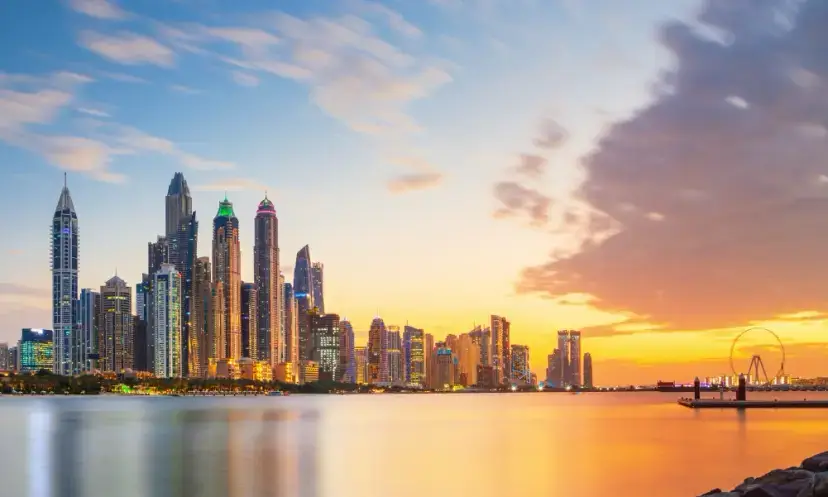

The Dubai Marina skyline is one of the most photographed cityscapes in the world – a dense cluster of glass towers, several over 300 metres tall, wrapped around a 3.5-kilometre man-made canal on the Arabian Gulf coast. It is both a visual icon of modern Dubai and one of the emirate’s most established freehold property markets, home to more than 200 residential towers and over 120,000 residents.
This guide explains what makes the skyline look the way it does, where Dubai Marina sits within the city, what it’s actually like to live there, and what buyers and investors need to know about property types, prices, and returns in 2026.
What Is the Dubai Marina Skyline?
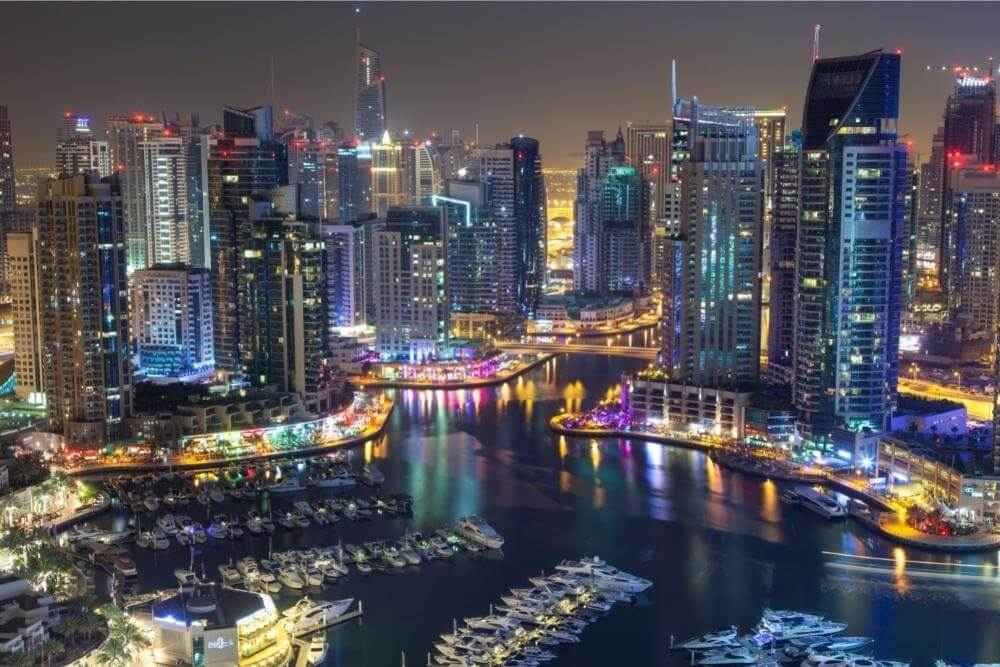
The term “Dubai Marina skyline” refers to the tightly packed high-rise cluster that surrounds Dubai Marina’s canal, stretching roughly from Sheikh Zayed Road to the Arabian Gulf shoreline. Unlike Downtown Dubai, where the Burj Khalifa dominates a comparatively open skyline, Dubai Marina’s identity comes from density: dozens of supertall and super-slim towers, many between 250 and 380 metres, standing shoulder to shoulder along the water. Locally, the most concentrated stretch of towers is sometimes referred to as the “Tallest Block,” a nod to the sheer number of high-rises packed into a small footprint – reportedly the highest concentration of skyscrapers in any single district anywhere in the world.
The skyline changes character completely between day and night. In daylight, sunlight bounces off glass facades and the turquoise canal, giving the district a bright, almost metallic sheen. After sunset, the towers become a wall of light reflected in the water, which is why sunset cruises, rooftop bars, and marina-facing hotel rooms are consistently in demand among both visitors and residents.
Where Is Dubai Marina Located?
Dubai Marina sits along a 3-kilometre stretch of Arabian Gulf coastline in what is often called “New Dubai,” between the Al Sufouh district and Jebel Ali. It is built directly off Sheikh Zayed Road (E11) at Interchange 5, roughly 25–30 minutes from Downtown Dubai and Dubai International Airport, and close to Dubai Internet City, Dubai Media City, and the American University in Dubai. This positioning matters commercially as well as residentially: a large share of Marina residents work in the nearby media and tech free zones, making it a practical live-work address rather than purely a resort district.
Connectivity is one of the district’s strongest selling points. Two Dubai Metro Red Line stations – Sobha Realty (the original Dubai Marina station, later renamed) and Jumeirah Lakes Towers – sit on either side of the community, linked by elevated walkways over Sheikh Zayed Road. The Dubai Tram runs a loop through the Marina and Jumeirah Beach Residence (JBR), connecting to the Palm Monorail at Al Sufouh. Water taxis and the Marina’s own ferry services add a third transport layer that few other Dubai districts offer, letting residents cross the canal by boat rather than walking around it.
The Towers That Define the Skyline
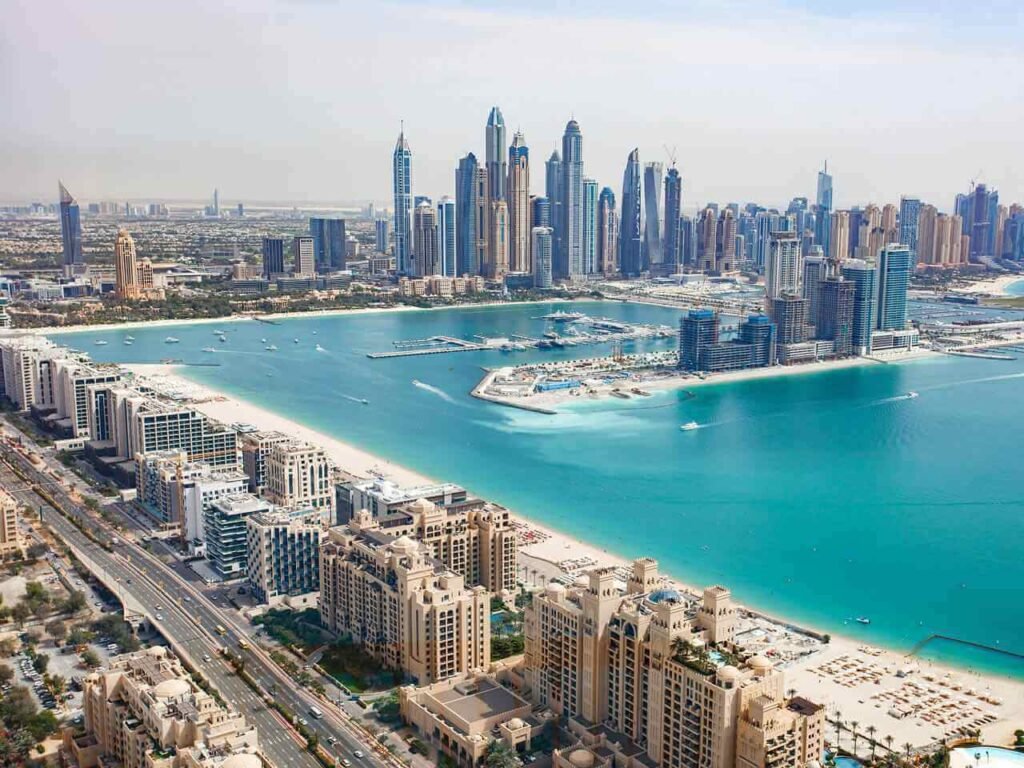
A handful of buildings do most of the work in making Dubai Marina instantly recognisable in photographs.
Princess Tower, at 101 storeys, was for years the tallest residential-only building in the world and remains one of the tallest in Dubai Marina. Cayan Tower is the district’s most photographed structure for a different reason: its distinctive 90-degree twist from base to rooftop makes it stand out even in a skyline full of tall buildings. Marina 101 and Elite Residence add further height to the cluster, while Ciel Dubai Marina, rising to 366 metres, holds the title of tallest hotel in the world and anchors the shoreline end of the district.
On the hospitality and mixed-use side, JW Marriott Marina, Grosvenor House, and Address Beach Resort are landmark buildings in their own right, each contributing to the skyline while also functioning as major dining and leisure destinations for the wider community. Emaar Properties, the district’s master developer, also delivered the original Dubai Marina Towers – six freehold buildings named after gemstones and Arabic scents – that formed Phase I of the development before the taller Phase II towers followed.
How the Marina Was Built: History and Master Plan
Dubai Marina was designed by architecture firm HOK and developed by Emaar Properties, reportedly drawing inspiration from the Concord Pacific Place waterfront development along False Creek in Vancouver, Canada. Rather than build along a natural coastline, developers excavated a channel from the desert and drew seawater from the Arabian Gulf into the site, creating an artificial marina now recognised as the largest man-made marina in the world.
Construction proceeded in phases. Phase I covered the original six Dubai Marina Towers on a 10-hectare site. Phase II brought the high-density cluster of skyscrapers that now defines the skyline, most standing between 250 and 300 metres, alongside taller landmark towers like Cayan and Ciel. More than 12% of the district’s total land area was reserved for the central waterway and nearly 8 kilometres of landscaped public walkways – a rare amount of public realm for a high-density Dubai community, and part of why the area still functions well as a pedestrian district today.
Lifestyle: What It’s Actually Like to Live in Dubai Marina
Dubai Marina Walk – the promenade tracing the canal – is the social spine of the district, stretching roughly 7 kilometres and lined with cafés, casual restaurants, and retail units at ground level. Residents use it for walking, running, and cycling, and it’s genuinely walkable in a way many newer Dubai communities are not, thanks to that early decision to prioritise public waterfront space.
Pier 7, a circular structure with a different restaurant on each of its seven floors, is the district’s best-known dining landmark, offering skyline and marina views from nearly every table. Dubai Marina Yacht Club anchors the boating side of the lifestyle, offering berths, watersports, and dhow or speedboat tours out into the Gulf – a popular way to see the skyline from the water rather than the shore. Dubai Marina Mall, opened in 2008 and linked to the JW Marriott, holds around 140 retail outlets and is the district’s main indoor shopping and entertainment hub, complemented by the outdoor retail strip at The Walk, JBR, just across the tram line.
The community skews cosmopolitan and fast-paced. It’s popular with young professionals, airline crew, remote workers, and short-term corporate tenants, partly because of proximity to Dubai Internet City and Media City, and partly because of the sheer density of dining, nightlife, and short-let accommodation. Families do live in the Marina, but it’s worth being direct about a real trade-off: there are few schools directly inside the district (though nurseries are well represented), and peak-hour traffic around Sheikh Zayed Road can make school runs slower than in villa communities further from the highway. Families prioritising walk-to-school access often look at neighbouring areas instead, while those who value beach access, nightlife, and dining choose the Marina specifically because of that trade-off, not despite it.
Pet owners generally find the Marina workable – several buildings allow pets, and the waterfront promenade doubles as a walking route – though ground-floor outdoor space is limited compared with villa communities, so it suits smaller pets and apartment living better than large dogs needing a private garden.
Beaches, Parks, and Nearby Attractions
Marina Beach and the adjacent JBR Beach (The Beach at JBR) give residents direct sea access within a short walk or one tram stop of most Marina towers. Both are public beaches with sun loungers, watersports operators, and beachfront dining. Ain Dubai, the giant observation wheel on nearby Bluewaters Island, and Palm Jumeirah are both visible from many upper-floor Marina apartments and are a short drive or water-taxi ride away, which is part of why Marina-facing units with unobstructed sea views command a premium over canal- or community-facing units in the same building.
Property Types in Dubai Marina
Dubai Marina is overwhelmingly an apartment market. Stock ranges from compact studios to expansive four- and five-bedroom penthouses, spread across roughly 200 residential towers with a wide spread of building age, from the original mid-2000s Emaar towers to newer, more amenity-rich developments. Layouts and finishes vary significantly by building, and view quality – full marina view, partial view, or community/land-facing – is one of the biggest single drivers of price within the same tower.
Villas exist but are genuinely limited. Al Sahab, a two-tower waterfront development overlooking the Marina’s largest bay, and a small number of podium villas attached to select towers, are the main options, typically ranging from two to six bedrooms and 2,450 to 9,600 square feet. Buyers specifically wanting a villa lifestyle in this part of Dubai more often look at nearby communities rather than the Marina itself, where land is essentially built out.
Commercial and retail space also exists at ground and podium level across the district, largely occupied by the restaurants, cafés, salons, supermarkets, and clinics that serve residents, though the Marina is not primarily a commercial office address – that role is filled by neighbouring Jumeirah Lake Towers and Dubai Internet City.
Dubai Marina Property Prices in 2026
As of mid-2026, average apartment prices in Dubai Marina sit in the range of roughly AED 2,050 to AED 2,650 per square foot, depending on the data source, building age, and view category, based on Dubai Land Department transaction records tracked by Property Monitor, Bayut, and other market platforms. The district-wide figure moves month to month – one mid-2026 index put the average closer to AED 2,300/sqft with a slight year-on-year softening, while a broader Property Monitor read for the same period showed roughly AED 2,058/sqft – which is a useful reminder that “Dubai Marina” is not one uniform micro-market. A renovated unit with a full marina view in a premium tower and a dated studio in an older building can sit AED 500–800 per square foot apart even in the same postcode.
In transaction terms, one- to three-bedroom waterfront apartments typically range from around AED 2 million to AED 4.5 million, with studios starting lower and branded or penthouse-level units running well beyond that. Off-plan supply is genuinely limited compared with newer Dubai districts, since the Marina is close to fully built out; the projects that do launch – such as Select Group’s Beach Mansion or Emaar’s Grand Bleu Tower – tend to be premium, smaller in unit count, and priced at a premium to surrounding ready stock.
Rental Trends and Yields
Dubai Marina remains one of Dubai’s most consistently rented districts, and that liquidity is arguably its biggest advantage for landlords: vacant periods tend to be short because tenant demand – from young professionals, airline crew, corporate relocations, and short-term visitors – is constant. Gross rental yields across the district typically run between 5.5% and 7.2%, with well-managed short-let units in strong locations occasionally pushing higher. Long-term rents vary widely by building and unit size, with studios generally starting in the low AED 60,000s per year and one- and two-bedroom units moving up from there depending on tower, floor, and view.
That said, yields have compressed somewhat as capital prices have climbed, and older towers – some now over 15 years old – can carry higher service charges that quietly erode net returns even when headline rent looks strong. For investors comparing Dubai Marina against newer communities, the trade-off is straightforward: steadier, more predictable demand and faster resale versus slower capital growth than emerging districts and closer attention needed to service charges and building condition.
Investment Potential and ROI
Dubai Marina sits in a freehold zone, meaning foreign buyers and expatriates can acquire 100% ownership of property, register the title with the Dubai Land Department, and hold it in their own name without a local partner. That legal clarity, combined with the district’s transaction volume and international name recognition, keeps it one of the more liquid and beginner-friendly entry points into Dubai real estate for overseas investors.
The investment case for 2026 rests on a few structural points rather than short-term price momentum. First, the Marina is essentially built out – there is very little land left for new towers, which limits future oversupply risk relative to districts still absorbing large amounts of new stock. Second, new 2026 building regulations pushing green retrofits and smarter building management are gradually improving the operating cost and appeal of older towers, which had been a relative weak point. Third, proximity to Bluewaters Island, Ain Dubai, and Dubai’s growing cruise terminal infrastructure continues to support both long-term rental demand and short-let performance.
The realistic trade-off for investors is between the Marina’s stability and liquidity versus the sharper capital-growth potential of newer, still-developing districts. Buyers prioritising rental reliability and ease of resale over maximum appreciation tend to be well served by Dubai Marina; those chasing the fastest possible capital growth often look at emerging waterfront districts instead.
How to Buy Property in Dubai Marina
The buying process for both UAE nationals and foreign investors follows Dubai’s standard freehold purchase route. In brief: agree terms and sign a Memorandum of Understanding (Form F) with the seller, pay the standard deposit, obtain a No Objection Certificate (NOC) from the developer confirming no outstanding service charges or liabilities, and complete the transfer at a Dubai Land Department (DLD) registration trustee office, where the DLD’s 4% transfer fee applies alongside standard trustee and agency fees. Mortgage buyers will also need a bank valuation and pre-approval before the transfer date. Off-plan purchases follow a separate route through the developer directly, governed by RERA’s escrow account rules designed to protect buyer payments during construction.
Best Spots to View and Photograph the Dubai Marina Skyline
For anyone drawn to the Marina specifically for its skyline, a few vantage points consistently deliver the best results: the Marina Walk promenade itself, particularly the stretch opposite Cayan Tower, offers the classic reflected-skyline shot at sunset; the Pier 7 rooftop terraces give an elevated, panoramic view across the canal; and a short dhow or speedboat tour from the Marina Yacht Club puts the entire tower cluster in frame from the water, which is genuinely the only way to appreciate the full scale of the district in a single view. Upper-floor apartments and hotel rooms facing the canal or the Gulf offer the same view daily, which is one of the quieter reasons marina-facing units in this district hold their value.
Who Dubai Marina Suits Best
Dubai Marina works well for young professionals and couples who want walkability, nightlife, and dining on their doorstep; for investors prioritising rental liquidity and ease of resale over maximum capital growth; and for anyone who wants direct beach and sea access without paying Palm Jumeirah-level prices. It suits families less naturally than villa communities or newer master-planned districts with schools built in from day one, and it suits buyers seeking absolute quiet less well than lower-density coastal areas, given the concentration of restaurants, tourism, and short-let activity.
FAQs
What makes the Dubai Marina skyline unique compared to Downtown Dubai?
Downtown Dubai’s skyline is defined by a single dominant landmark, the Burj Khalifa, set within a more open streetscape. Dubai Marina’s skyline is defined by density – dozens of towers between 250 and 380 metres clustered tightly around a canal, which is why it’s often described as having the highest concentration of skyscrapers of any district in the world.
How tall is the tallest building in Dubai Marina?
Ciel Dubai Marina rises to 366 metres and holds the title of tallest hotel in the world. Princess Tower, at 101 storeys, was for years the tallest residential-only building globally and remains among the tallest towers in the district.
Is Dubai Marina a good place to invest in property in 2026?
It suits investors who value rental liquidity, quick resale, and low future oversupply risk, since the district is nearly built out. Average prices in mid-2026 sit around AED 2,050–2,650 per square foot with gross rental yields typically between 5.5% and 7.2%. Buyers seeking the fastest possible capital appreciation may find newer, still-developing districts more suited to that goal.
Can foreigners buy property in Dubai Marina?
Yes. Dubai Marina is a freehold zone, so foreign nationals and expatriates can purchase property with 100% ownership, registered directly with the Dubai Land Department.
Is Dubai Marina good for families?
It offers strong lifestyle amenities – beach access, walkability, dining – but has few schools directly within the district (though nurseries are plentiful), and peak-hour traffic on Sheikh Zayed Road can complicate school commutes. Families prioritising on-site schooling often prefer nearby master-planned communities instead.
What are the two metro stations serving Dubai Marina?
Sobha Realty Station (the original Dubai Marina station) and Jumeirah Lakes Towers Station, both on the Dubai Metro Red Line, sit on either side of the district and connect via elevated walkways over Sheikh Zayed Road. A separate Dubai Tram loop runs through the Marina and JBR.
How much does it cost to rent an apartment in Dubai Marina?
Rents vary widely by building, size, and view, but studios typically start in the low AED 60,000s per year, with one- and two-bedroom units moving up from there. Marina-facing units in premium towers command a clear premium over land- or community-facing units in the same building.
What is the average price per square foot in Dubai Marina in 2026?
Roughly AED 2,050 to AED 2,650 per square foot, according to Dubai Land Department transaction data tracked through mid-2026, though the figure varies by building age, condition, and view quality.
Are there villas in Dubai Marina?
Villa stock is very limited. Al Sahab and a small number of podium villas attached to select towers are the main options, typically ranging from two to six bedrooms. Buyers wanting a broader villa selection generally look at neighbouring communities.
Is Dubai Marina walkable?
Yes, notably so for a high-density Dubai district. The Marina Walk promenade stretches roughly 7 kilometres along the canal, and more than 12% of the district’s land was reserved for the waterway and public walkways during the original master plan.
What is the rental yield in Dubai Marina compared to other Dubai areas?
Dubai Marina’s gross yields of roughly 5.5–7.2% sit below higher-yield mid-market areas like JVC (7–9%) but above lower-yield prime districts like Downtown Dubai (5–6%) and Palm Jumeirah (4–6%), reflecting its position as an established, liquid, mid-to-premium waterfront market.
Who developed Dubai Marina?
Emaar Properties was the master developer, with the district designed by architecture firm HOK. The original concept reportedly drew inspiration from the Concord Pacific Place waterfront development in Vancouver, Canada.
Is Dubai Marina an off-plan or ready property market?
Predominantly ready property, since the district is close to fully built out. A small number of premium off-plan projects still launch periodically, such as Select Group’s Beach Mansion and Emaar’s Grand Bleu Tower.
What is the best way to see the Dubai Marina skyline?
The Marina Walk promenade at sunset, a rooftop table at Pier 7, or a short dhow or speedboat tour from the Dubai Marina Yacht Club each offer a different, complete view of the tower cluster.
Looking to buy, sell, or rent in Dubai Marina? Explore current Dubai Marina listings or speak with a DubaiPropertyPlus advisor for building-by-building pricing, yield comparisons, and off-market opportunities.

Leave a Reply